Sometimes the best travel moments are the ones you never plan. After an underwhelming first hotel in Chengdu, we switched to a new one. At breakfast the next morning, a painted travel map on the wall caught our eye — the nearby Wenshu Monastery (文殊院) was marked, and we had no idea what it was. Curious and free, we walked over. What a surprise: it turned out to be a historic, beautifully built, and deeply revered temple, home to a skull relic of the great monk Xuanzang.
A Serendipitous Find at Wenshu Monastery
That morning, we saw the map and decided to check out the monastery simply because it was close. We arrived with zero expectations and left amazed. Wenshu Monastery isn’t just any temple — it’s been standing for over 1,400 years, with exquisite architecture, thriving incense, and a precious relic that draws pilgrims and travelers alike.
A History Spanning 1,400 Years
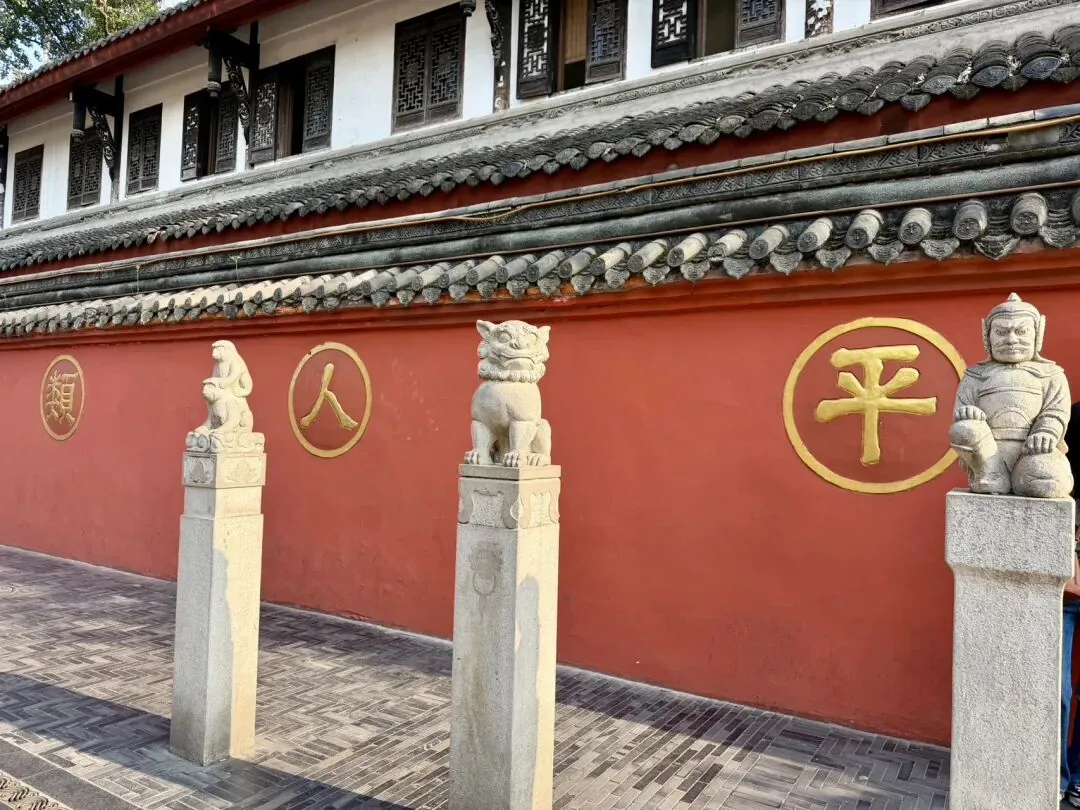
The monastery’s story begins in the Sui Dynasty. It was first built during the Daye era (605–617 AD), when a beloved consort of Prince Yang Xiu (the son of Emperor Wen of Sui) had it constructed for the nun Xinxiang, under the name Xinxiang Temple. According to the Chengdu County Gazetteer, in 1644, when Zhang Xianzhong’s army entered Sichuan, all Buddhist temples in Chengdu were burned. Xinxiang Temple was destroyed too — only 10 iron statues of guardian deities and two ancient cedars survived. Later, during the Kangxi period (1697–1706), the monk Cidu built a hut among the ruins and practiced there, gaining such a reputation that people donated funds to rebuild the temple. It was then renamed Wenshu Monastery.
After the founding of the People’s Republic of China, the Chengdu municipal government funded several restorations. In 1983, the State Council designated it a key Buddhist temple for the Han Chinese region. It also holds the distinction of being the foremost of the four great Chan monasteries in the Yangtze River basin.
The Grand Central Axis and the Monastery’s Layout
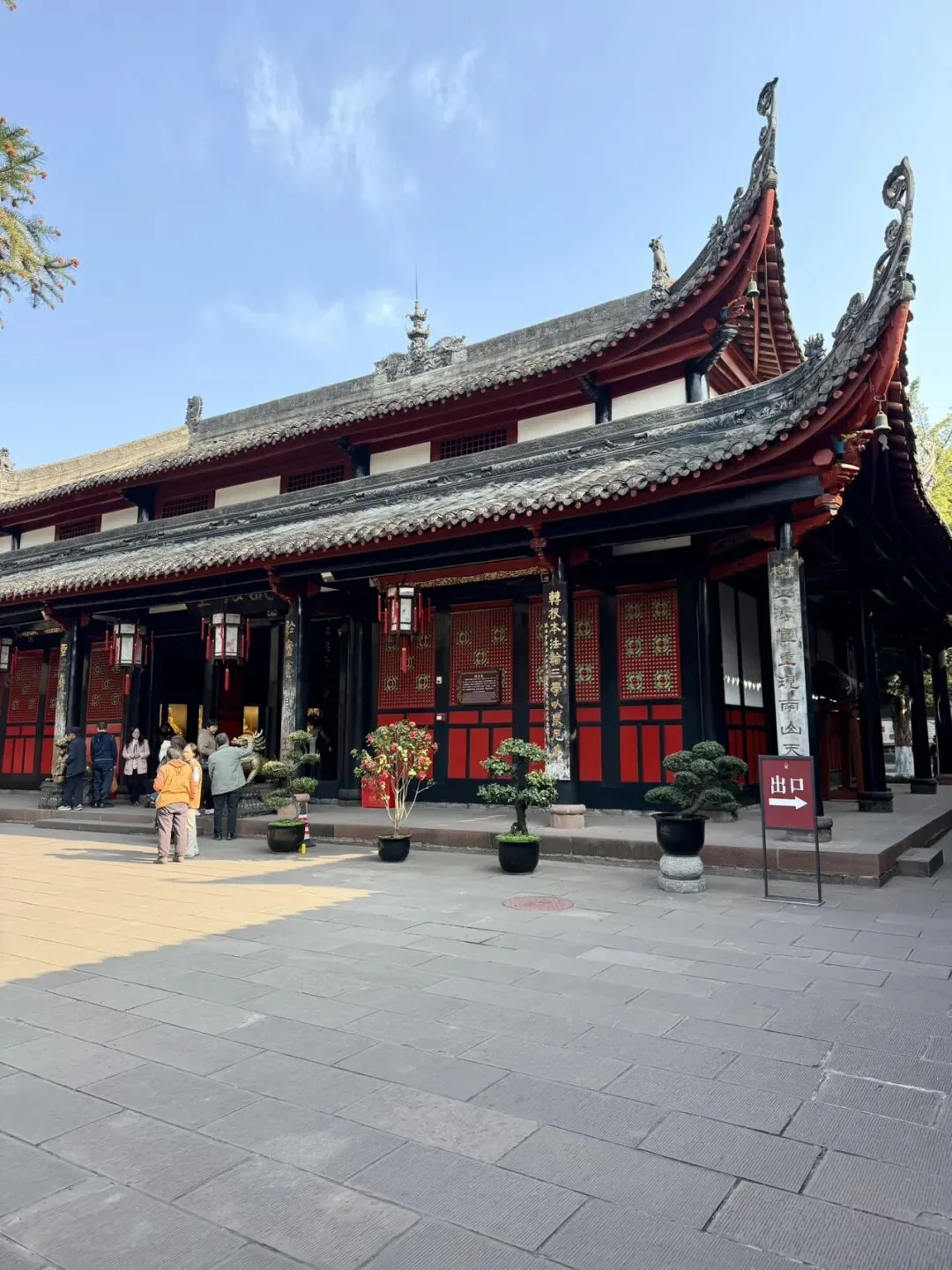
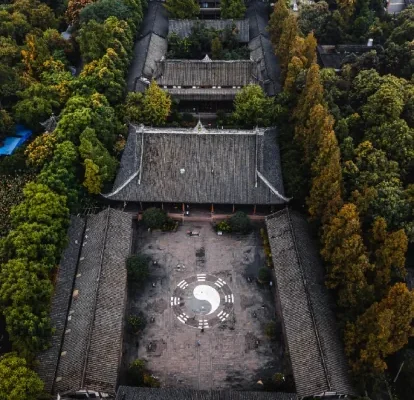
Step through the mountain gate and you’ll be struck by the scale and order. The main structures face south and stretch along a central axis with six grand halls, arranged in order: the Heavenly King Hall, the Three Sages Hall, the Great Buddha Hall, the Preaching Hall, and the Sutra Depository. These, along with the bell tower, dining hall, and corridors on the east and west, form layered courtyard after courtyard.
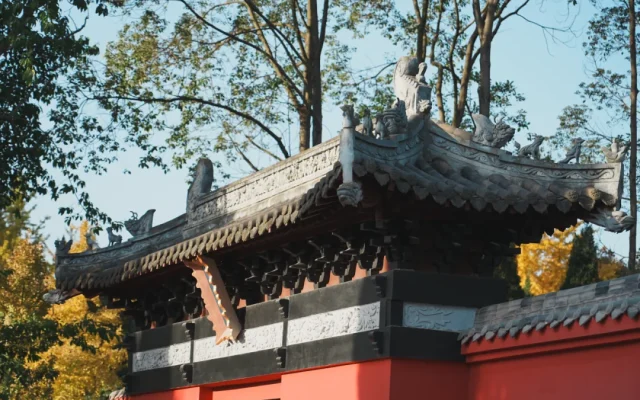
The buildings are all wooden structures in Qing Dynasty style, remarkably well preserved. Curved eaves and carvings are exquisite, while freshly painted red-and-black pillars and lattice windows give everything a dignified, ancient charm. Devout worshippers gather in front of each hall, adding to the temple’s living energy.
And it’s big — really big. The whole complex covers over 50,000 square meters, with halls, rooms, corridors, a tall pagoda, and a forest of steles, all shaded by ancient trees. If you want to explore thoroughly, set aside half a day — or even a full day.
The Pagoda, Stele Forest, and Zen Sayings
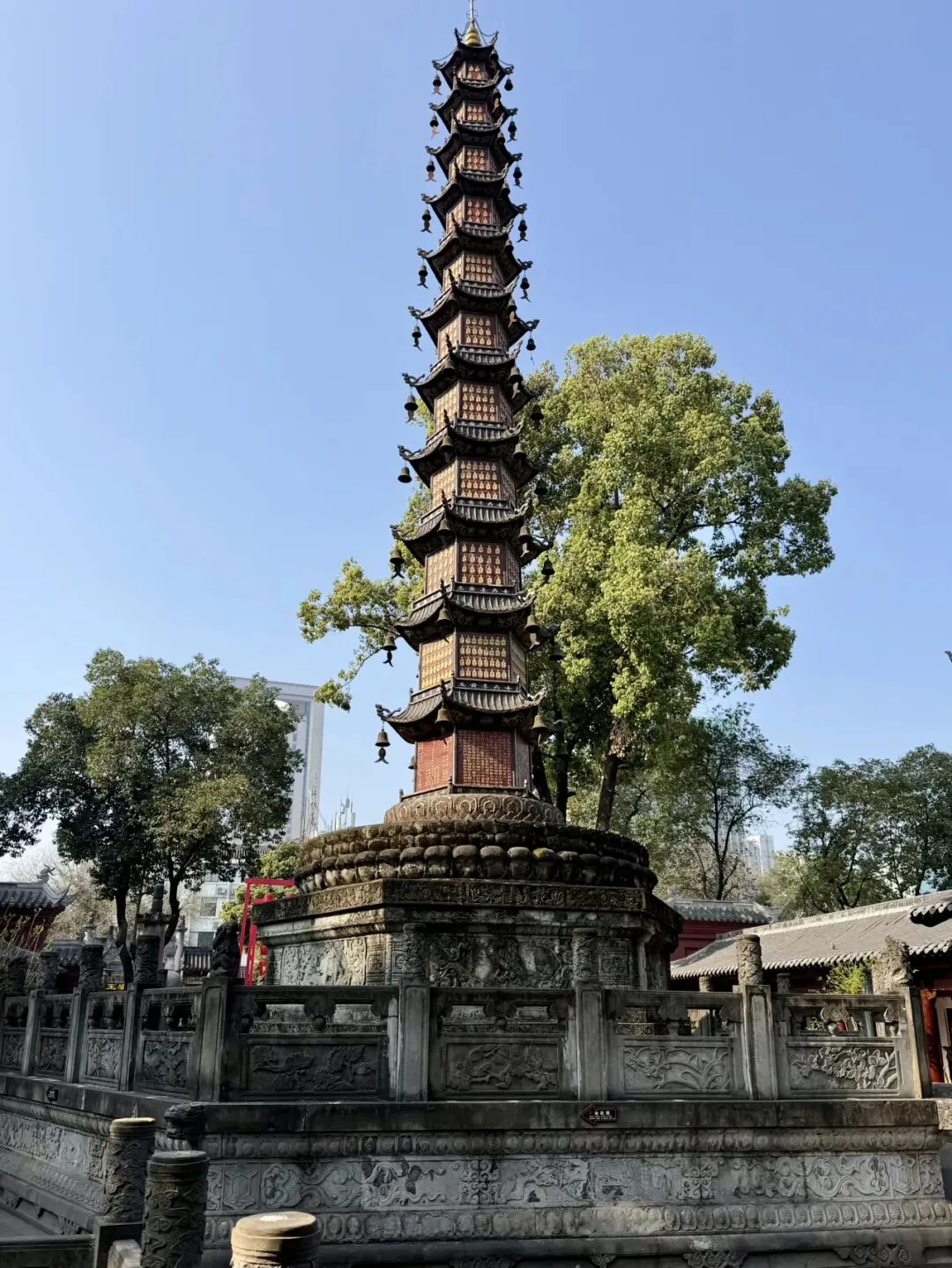
In the center of the temple grounds stands the Thousand-Buddha Peace Pagoda, built in 1988, with a plaque and couplet inscribed by Mr. Zhao Puchu. The hexagonal pagoda has bells hanging from each eave. It stands 21 meters tall with 11 tiers, and houses 1,000 Buddha statues — which is exactly how it got its name. The base is a carved stone lotus throne, surrounded by two rings of stone railings: the inner ring carved with floral patterns, the outer ring with scenes from Journey to the West.
On the pagoda’s east, west, and north sides, you’ll find a long stele corridor. These stone carvings display inscriptions and poems from imperial courts, officials, and famous figures throughout history, as well as calligraphy from the monastery’s own eminent monks — a genuine forest of steles and a treasure trove of calligraphy.
On the east side of the monastery, there’s a place serving vegetarian meals and tea, set among lush trees with a calm, elegant atmosphere. Stroll along the nearby woodland paths, and you’ll see elderly folks relaxing in pavilions while pigeons perch close by.
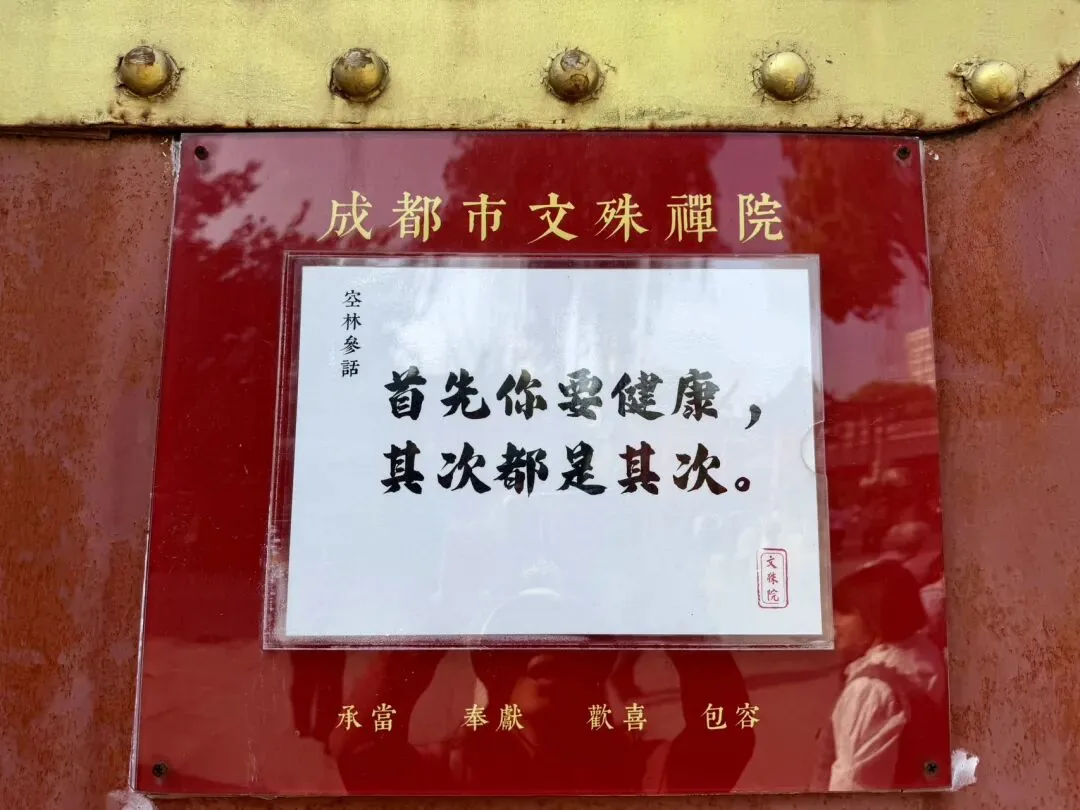
Even casual visitors stop to read the calligraphy scrolls hanging along the corridors and walls. They’re full of everyday wisdom, like “Worrying is unnecessary torment; mindfulness is the power of safety” and “First, be healthy; everything else is secondary.”
Local insight: Those scrolls aren’t just decoration — they’re a gentle nudge to slow down and reflect. Take a moment to read a few as you wander.
The Extraordinary Connection with Master Xuanzang
The Journey to the West carvings on the pagoda are no coincidence — the monastery houses a skull relic of the real Xuanzang, the Tang Dynasty monk whose journey inspired the novel. The relic is only open to the public once a year, on the anniversary of Xuanzang’s passing, when the temple holds a solemn “Xuanzang Relic Veneration Ceremony.”
How did this relic end up here? It’s a story full of twists. Although Xuanzang neither died nor was buried in Chengdu, he spent five years of his youth in the city and officially received his monastic precepts at Daci Temple here at age 21. After his death, his relics endured many trials and were moved from place to place. In 1942, his skull relic was discovered at the site of the old Dabao’en Temple in Nanjing. Because of his deep ties to Chengdu, a precious portion of the relic was brought to Wenshu Monastery in 1965.
If you’ve ever read Xuanzang’s own account, the Great Tang Records on the Western Regions, you know it’s dense and sometimes hard to digest. But when you think about what it describes — a journey in the Tang Dynasty that took 16 years and covered more than 50,000 li — you can’t help but feel awe. Xuanzang was focused, willful, extraordinarily intelligent and fit, and fluent in multiple languages. He traveled alone, completing not just his quest for scriptures but also an incredible record of geography, politics, and culture along the way.
The fictional Tang Sanzang in Journey to the West is weak and easily fooled — but the real Xuanzang shares only one thing with his fictional counterpart: the fact of the pilgrimage and the firmness of his belief. Reading the Great Tang Records makes you respect him deeply. For Xuanzang and Wenshu Monastery, this is a reunion across a thousand years. And for you, visiting here is no small fate.
The Lively World Outside the Monastery
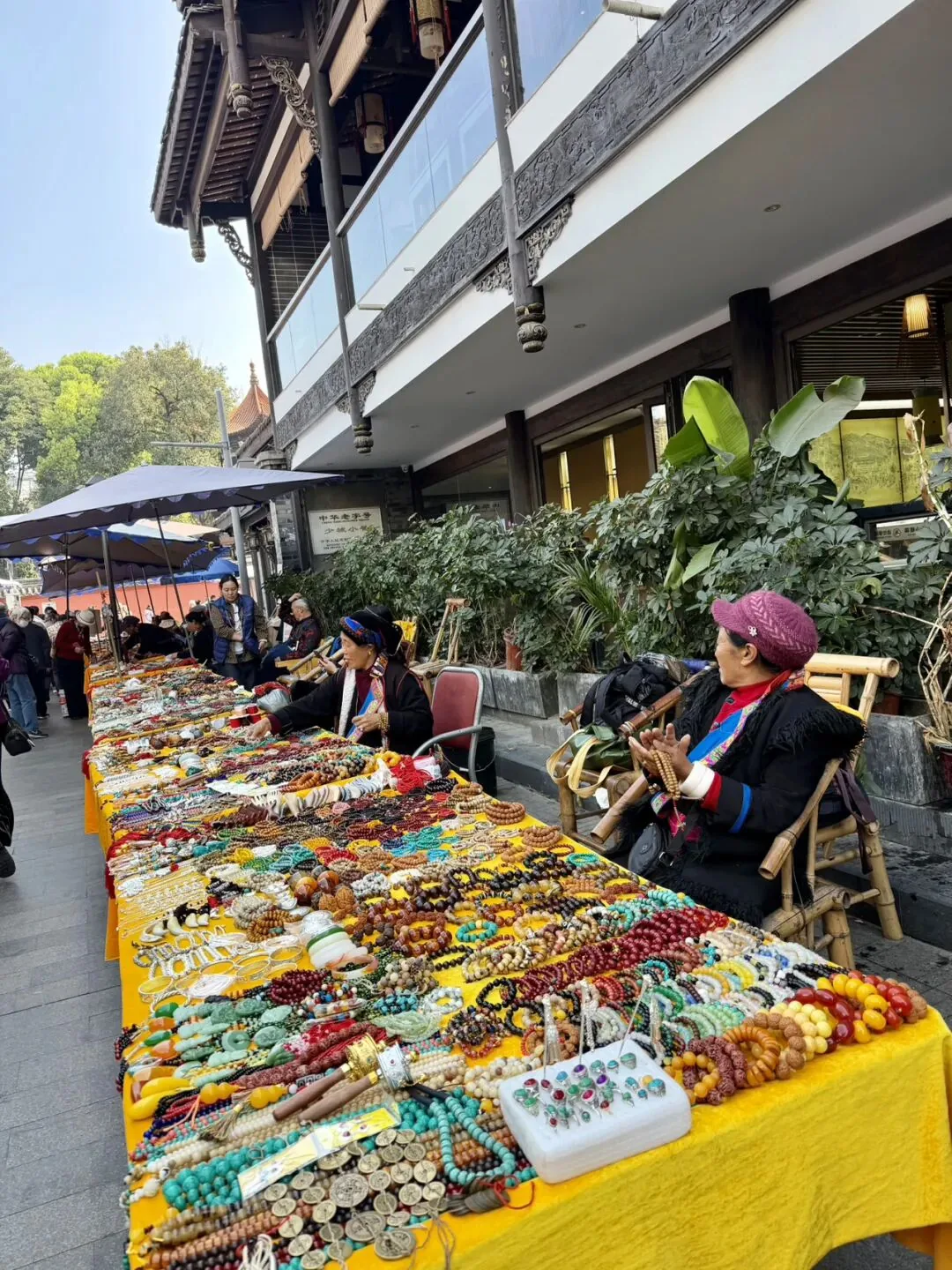
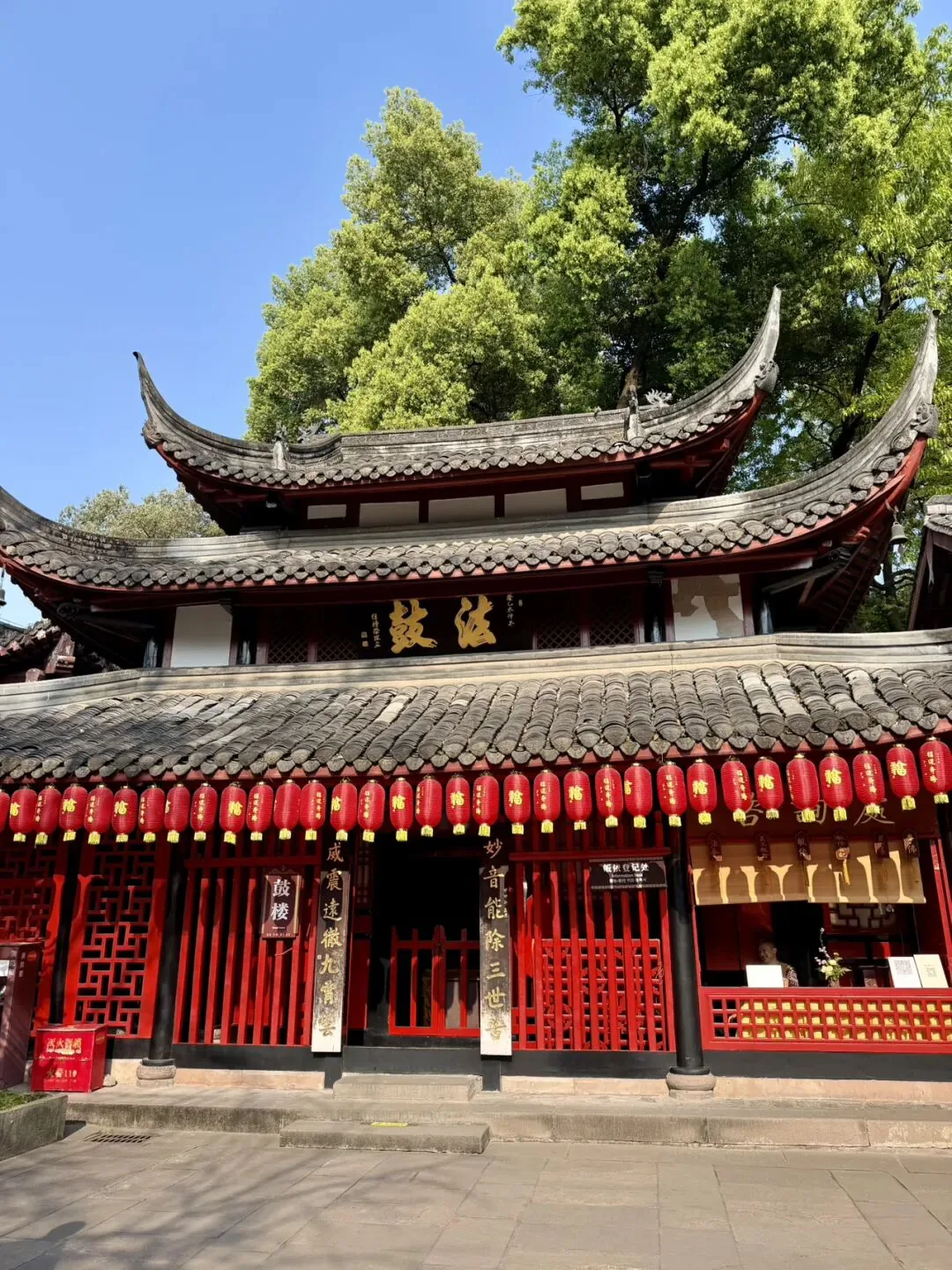
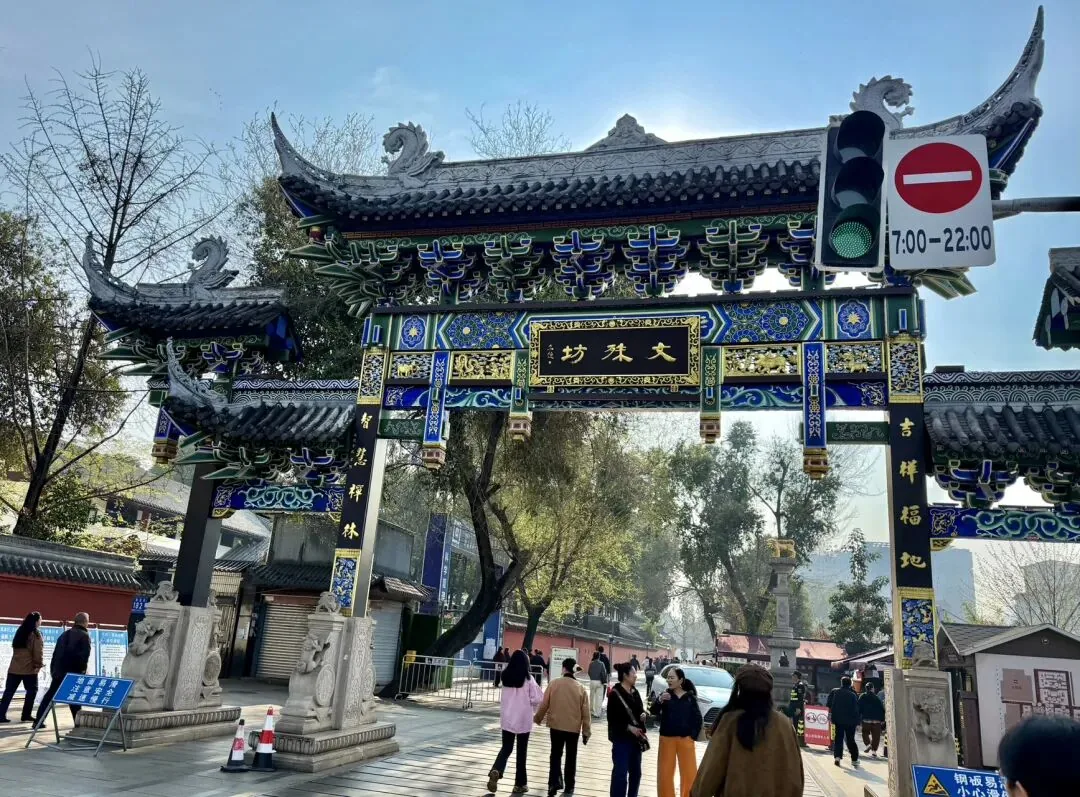
After all that history and serenity, step outside the walls and you’ll find a completely different vibe. Wenshu Fang (文殊坊) is a large archway that greets you before you even reach the temple. Inside the streets, red walls and green trees frame the “Happiness Wall” — a bright red wall that’s become a favorite photo spot for visitors.
The area around the monastery showcases old Chengdu architecture, and the food is classic local fare. You’ll find traditional pastries, Zhang Er Liang Fen (cold bean jelly), Long Chao Shou (a famous wonton dish), Yan Taipo Guokui (a filled flatbread) — pretty much any stall you choose will be bursting with fragrance.
One street devoted to bead and bracelet trinkets is especially eye-catching. Vendors in colorful ethnic clothing line up stall after stall, selling vibrant Tibetan-style accessories — necklaces, wrist beads, prayer wheels, and more. The whole street forms a wonderfully distinctive scene.
Our aimless stroll led us to a quiet sanctuary in the middle of the city, where we discovered a thousand-year-old temple and its bond with Master Xuanzang. It’s exactly the kind of unexpected surprise that makes travel so magical.