Chengdu Ginkgo Season: 6 Ancient Temple Trees & 6 City Streets Worth Planning Around
Every autumn, Chengdu turns gold for just two or three weeks. The old ginkgo trees in mountain temples color up first, then the city streets follow. This guide covers six temple ginkgo spots around Chengdu and six easy metro-accessible streets in town — with exact dates, prices, and routes so you don’t show up to bare branches during Chengdu ginkgo season.
Here’s the thing: a cold rain and one windy night can strip half the leaves. Don’t plan for the last possible day.
The 6 Best Ancient Temple Ginkgos Around Chengdu
1. Qingcheng Mountain’s Tianshi Ginkgo (Dujiangyan)
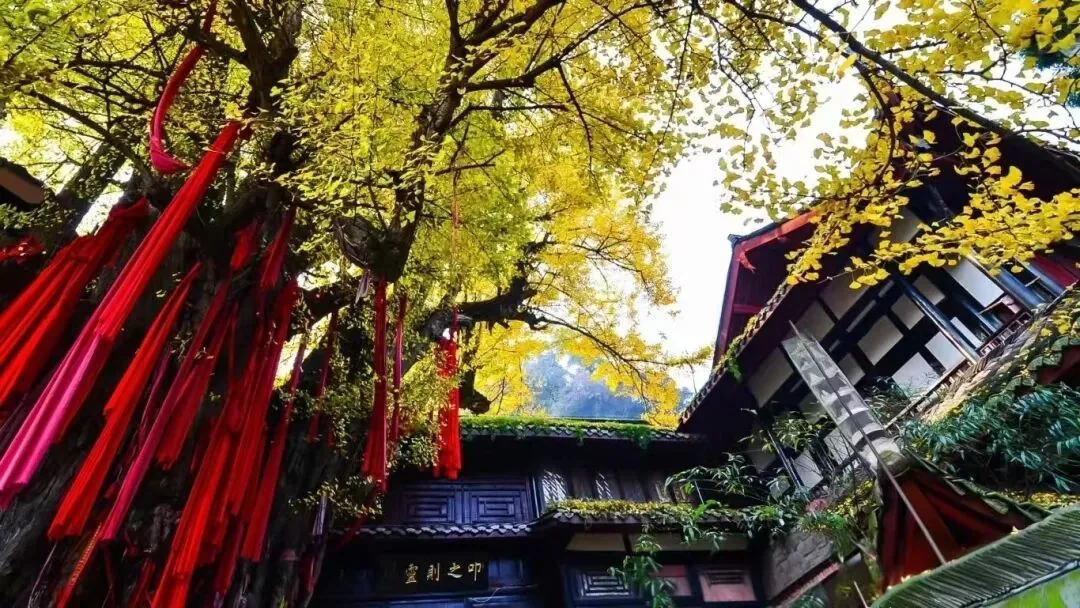
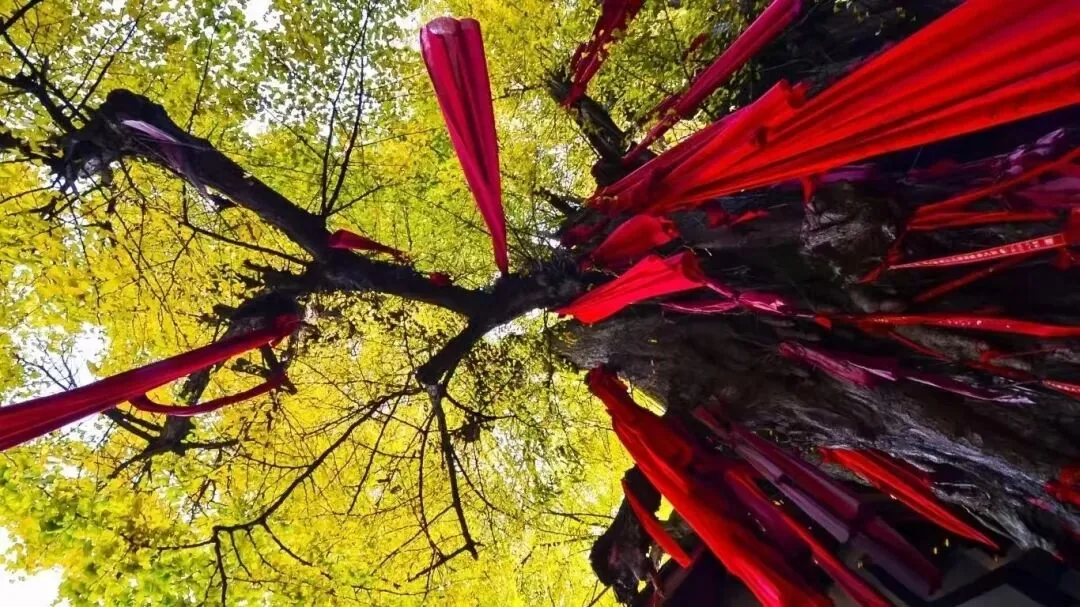
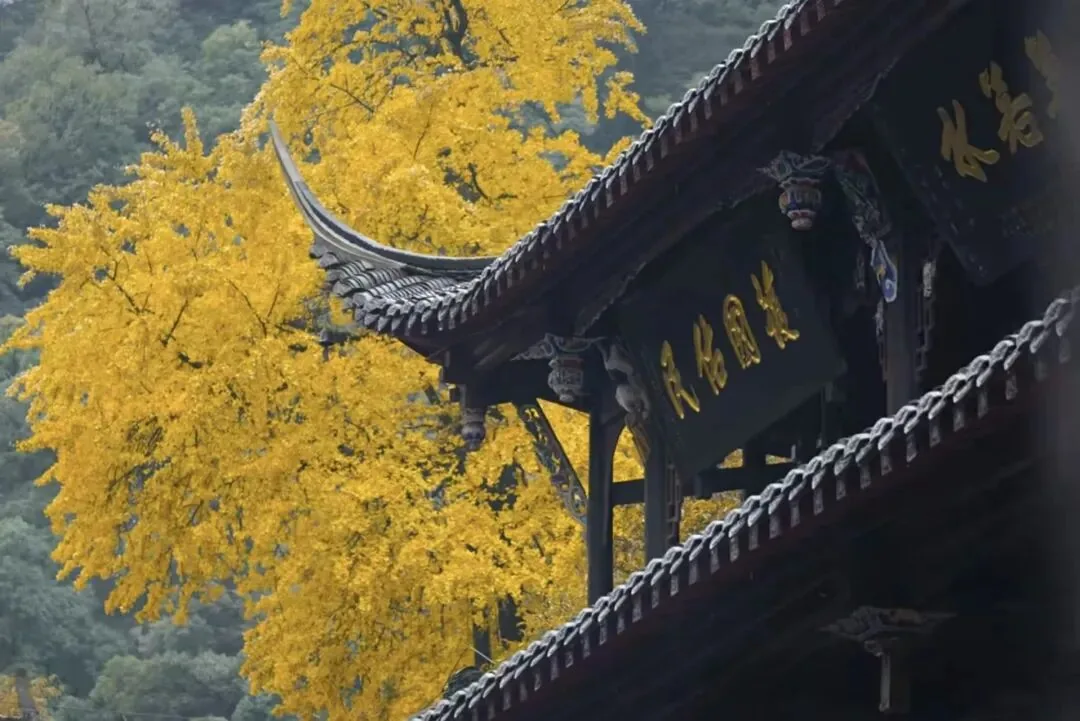
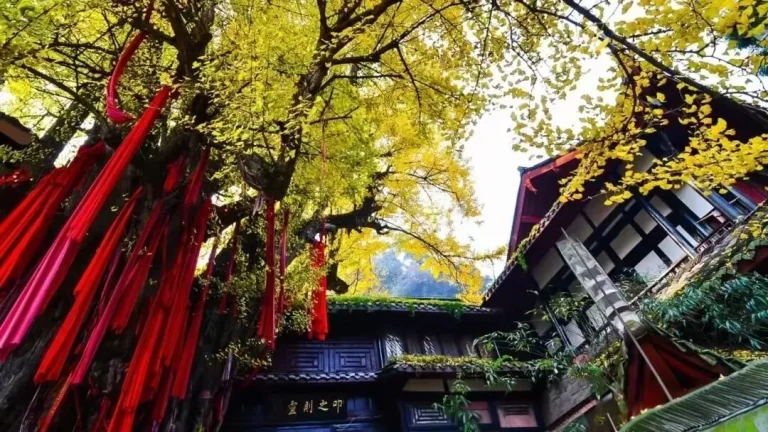
Inside Tianshi Cave (Tianshi Dong), this tree is said to have been planted by Zhang Daoling himself. It’s around 1,900 years old and ranks first among the “Ten Great Trees of Tianfu.” Red temple walls against a full canopy of gold make this the most impressive of the six.
Getting there: Navigate to “Qingcheng Mountain Front Mountain Scenic Area.” Take Metro Line 2 to Xipu, transfer to the Guan Express Train to Qingcheng Mountain Station, then bus 101 to the gate. By car, park at the Front Mountain parking lot. From the gate, it’s about a 40-minute walk up stone steps to Tianshi Cave.
Tickets: Front Mountain is 80 RMB, students 40 RMB. Tianshi Cave doesn’t charge extra. You need to reserve in advance via the “Qingcheng Mountain Dujiangyan” WeChat official account. From November 11–15, there’s an autumn holiday promotion: primary and middle school students nationwide get free daytime Front Mountain admission (not including cable car or sightseeing bus).
Best time: Mid-November to early December. Mornings 9–11 AM give the best photos. On weekends, try a weekday morning instead.
Nearby: Yuecheng Lake, Shangqing Palace, Laojun Pavilion, Dujiangyan Scenic Area, Jiezi Ancient Town, ginkgo stewed chicken…
2. Pengzhou’s Gexian Mountain Millennium Ginkgo
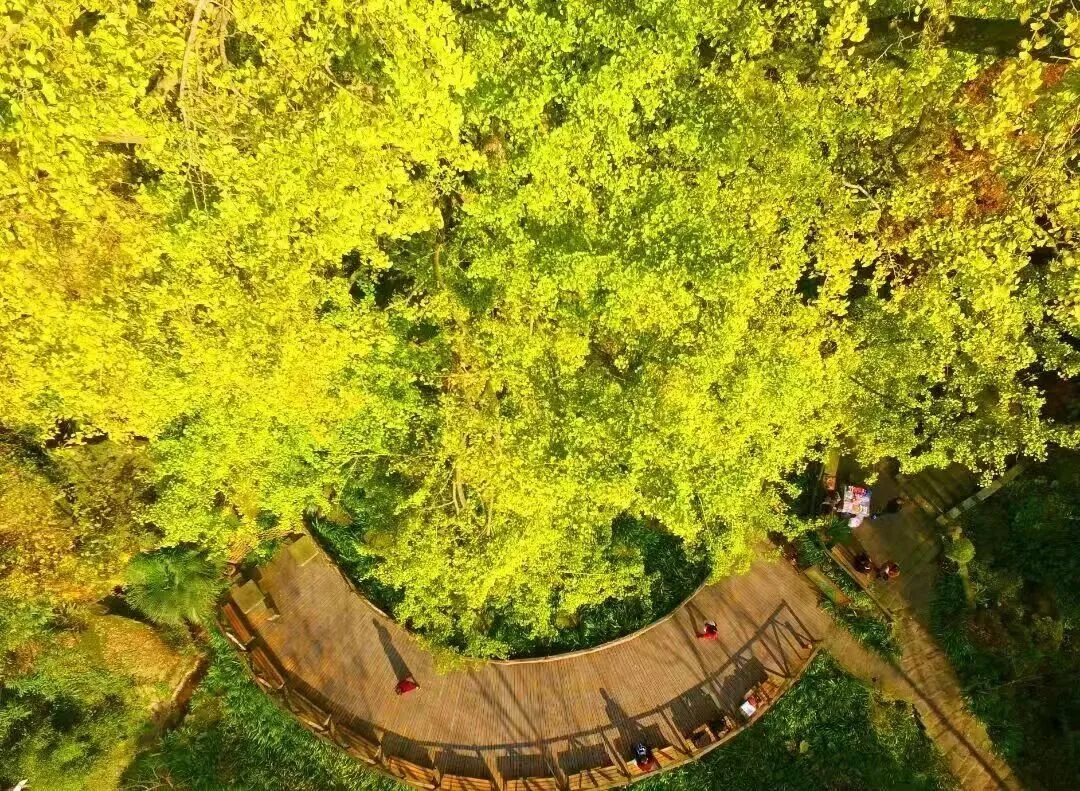
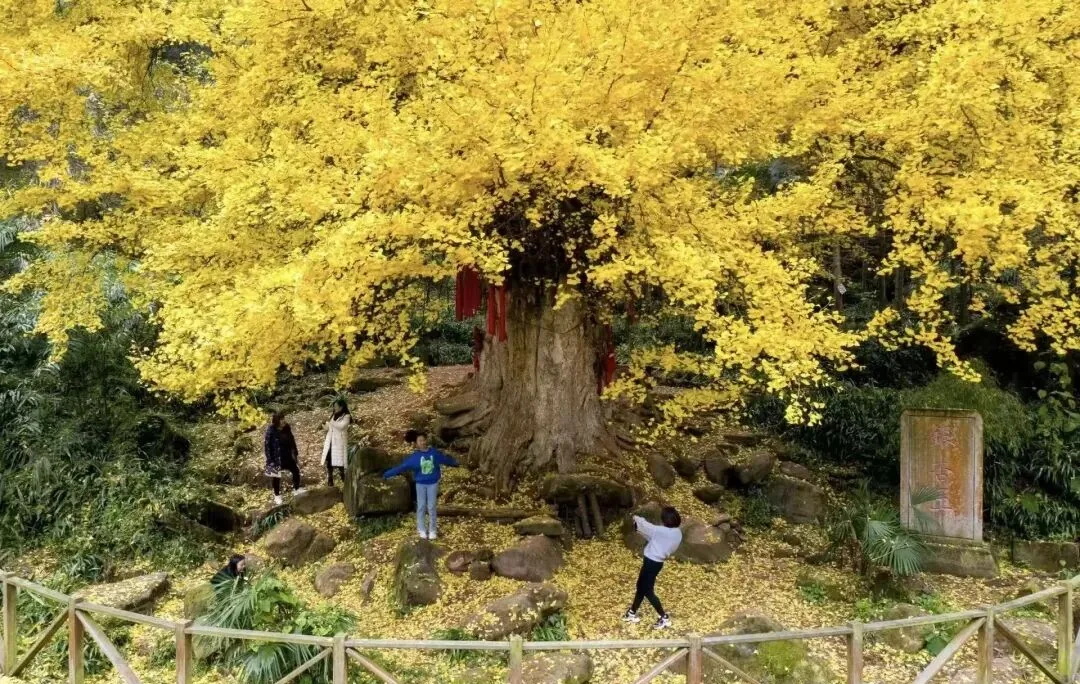
A gentle hill on the border of Bailu Town and Gexian Mountain Town, mixing geological wonders, Taoist temples, and farmland. The star is the thousand-year-old ginkgo king at Yinxing Ping (some sources say about 1,500 years old). Along the way you’ll also see redwood, camellia, karst caves, and the Yunju Temple Pagoda. The loop is 4–6 km and mostly flat — you can walk most of it with kids or a stroller.
Getting there: Navigate to “Gexian Mountain Scenic Area” or “Glacier Waterfall (Xiyu Village).” About 1.5 hours by car from Chengdu via Chengpeng Expressway to the Western Sichuan Tourism Ring Road. Parking is 10 RMB per car; arrive early on weekends.
Tickets: 20 RMB per person.
Best time: Mid-to-late November through December, but Gexian Mountain’s ginkgo drops early. In past years the branches were mostly bare by late November, so don’t wait until month’s end for a full canopy. Cave floors are slippery — bring a flashlight and hold onto the kids.
Nearby: Bailu Music Town, Bailu Shangshu Academy, Danjing Mountain, Longmen Mountain, Juntun guokui (flatbread), Jiuchi ban ya (cured duck)…
3. Lingyan Mountain’s Mid-Slope Temple Ginkgo (Dujiangyan)
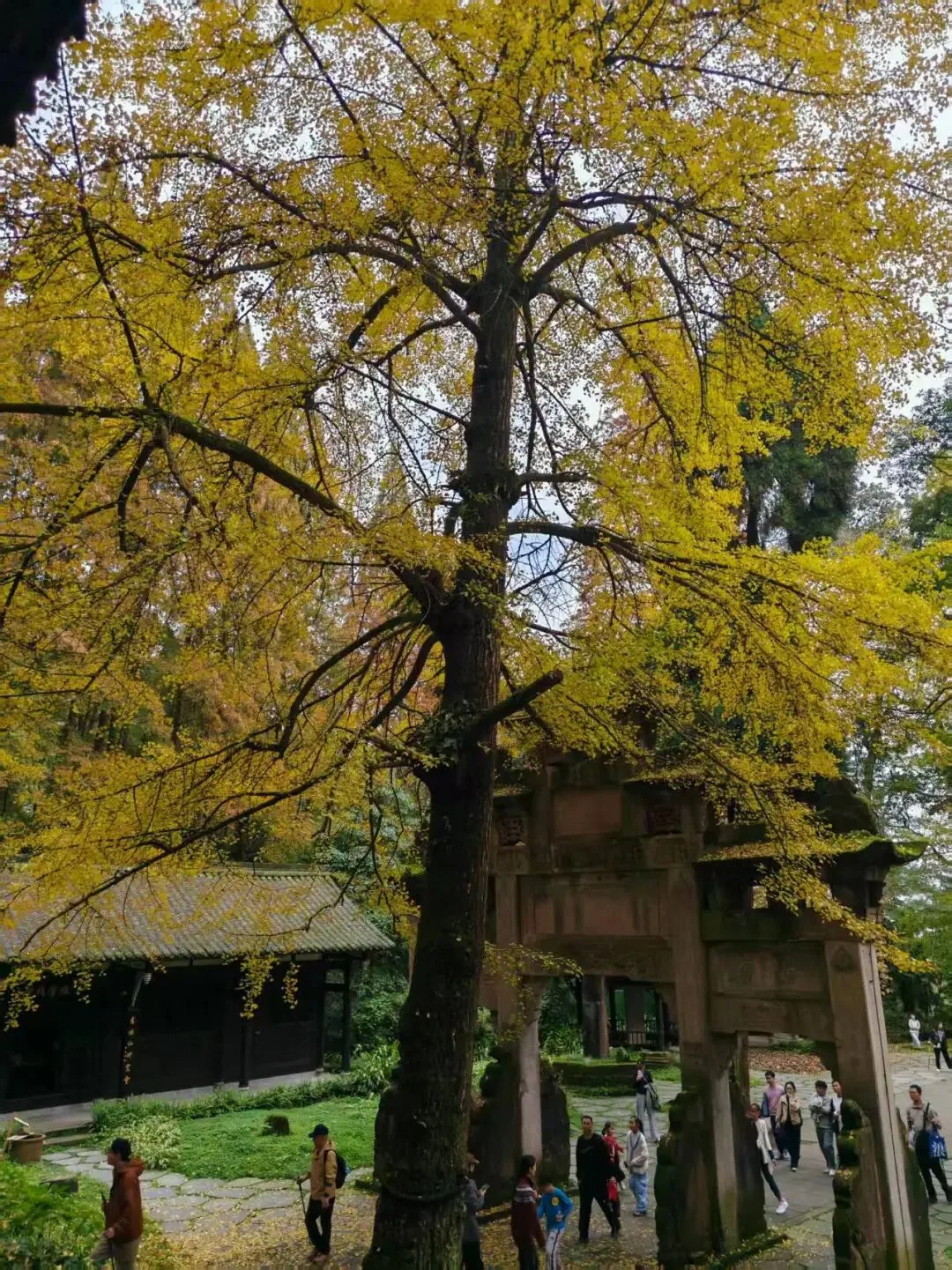
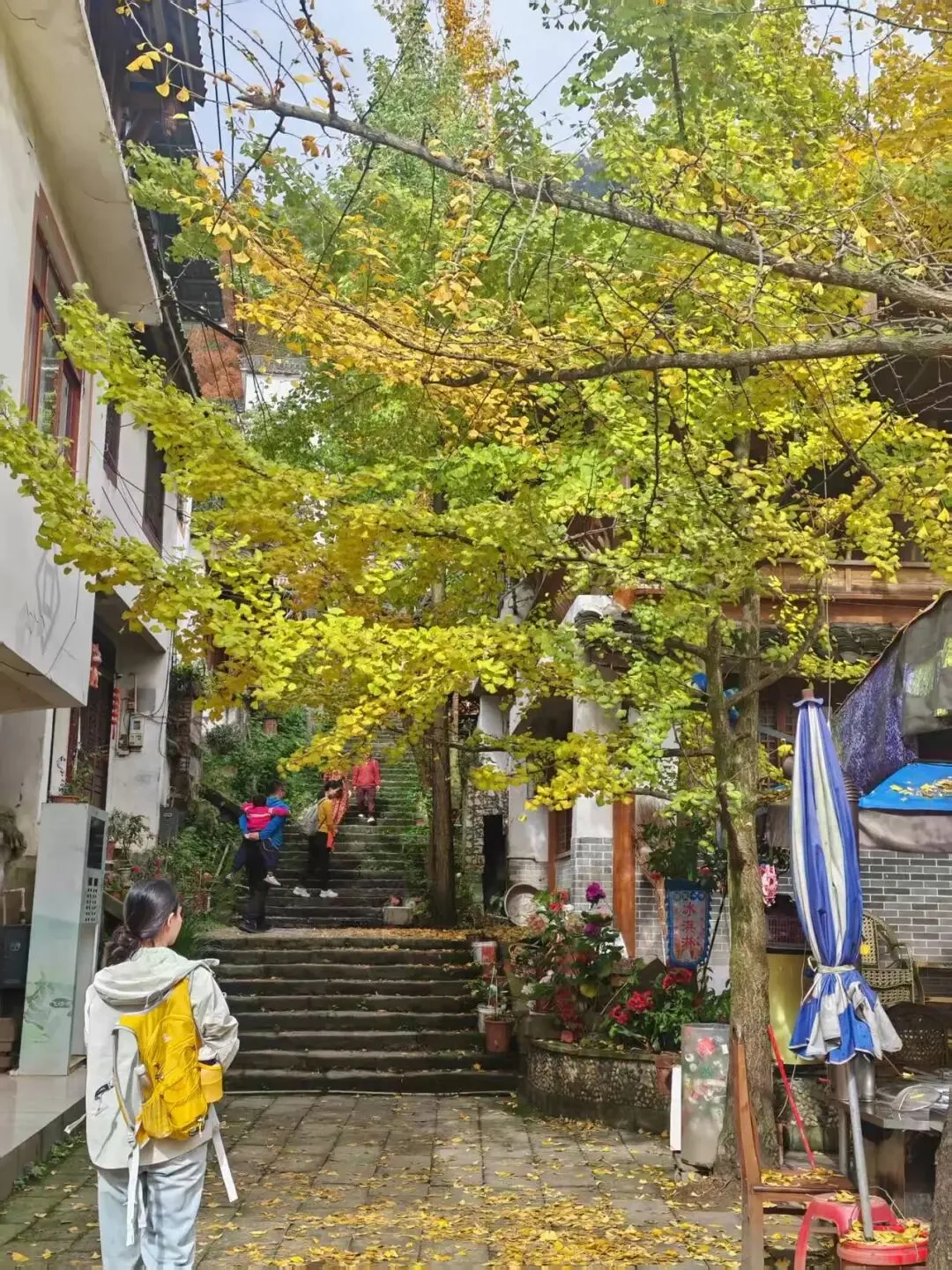
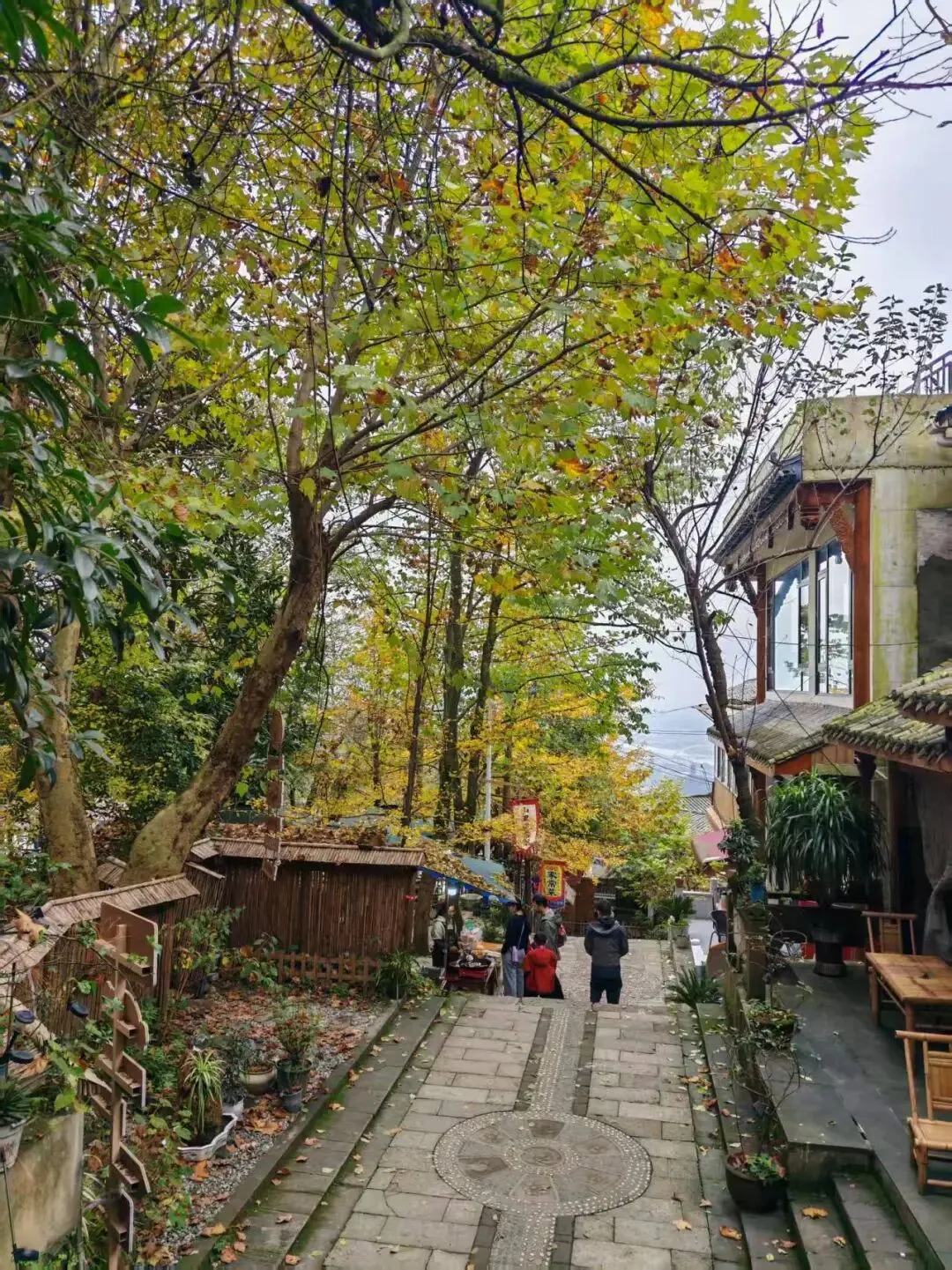
Head up from Lingyan Old Street in Guankou Subdistrict. The old temple hides in a fir forest, with ginkgo against stone steps, red walls, and mountain mist — Dujiangyan’s quietest autumn scene. The summit has open views; on a clear day you can look down over Dujiangyan city and the Min River. Even 2–4 year olds and elderly visitors can manage the walk.
Getting there: Navigate to “Lingyan Old Street Parking Lot” (the easier mid-slope route — get out and walk about 2–3 km of gentle stone steps to the temple). Fit families can park at “Erwang Temple Parking Lot” at the base and hike up.
Tickets: Entering the mountain and old street is free. Lingyan Temple and the academy are about 20 RMB; seniors and children free. Parking about 10 RMB per day.
Best time: The trees are still changing this year — give it another week. Weekend mountain roads are narrow, traffic makes passing hard, and scrapes are common. Arrive before 9 AM, drive slow, and keep to the side.
Nearby: Erwang Temple, Dujiangyan Scenic Area, Nanqiao Bridge, Guanxian Ancient City, Yangtianwo Square, Lidui Park…
4. Jintang’s Yunding Mountain Ciyun Temple “Husband and Wife” Ginkgos
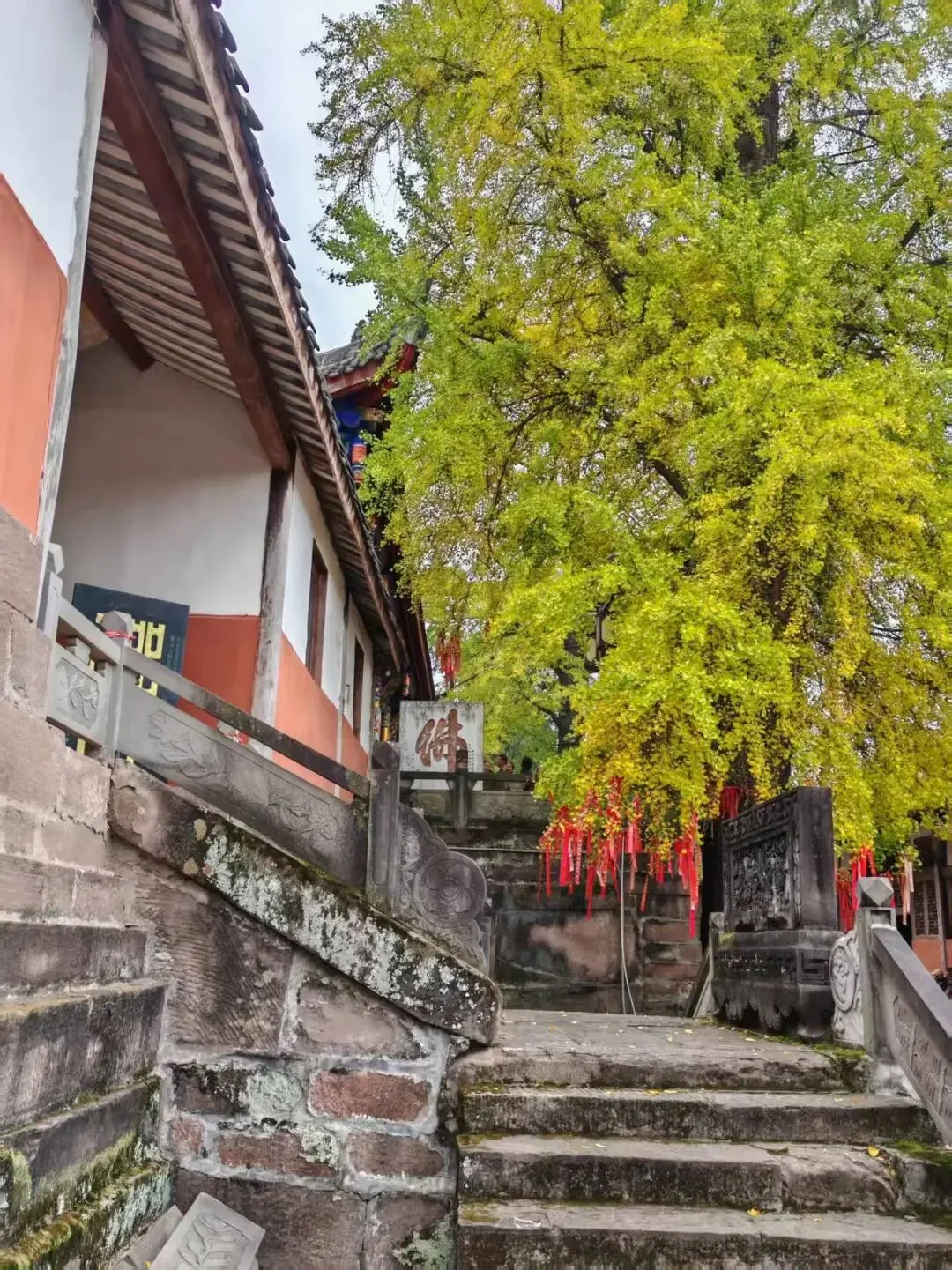
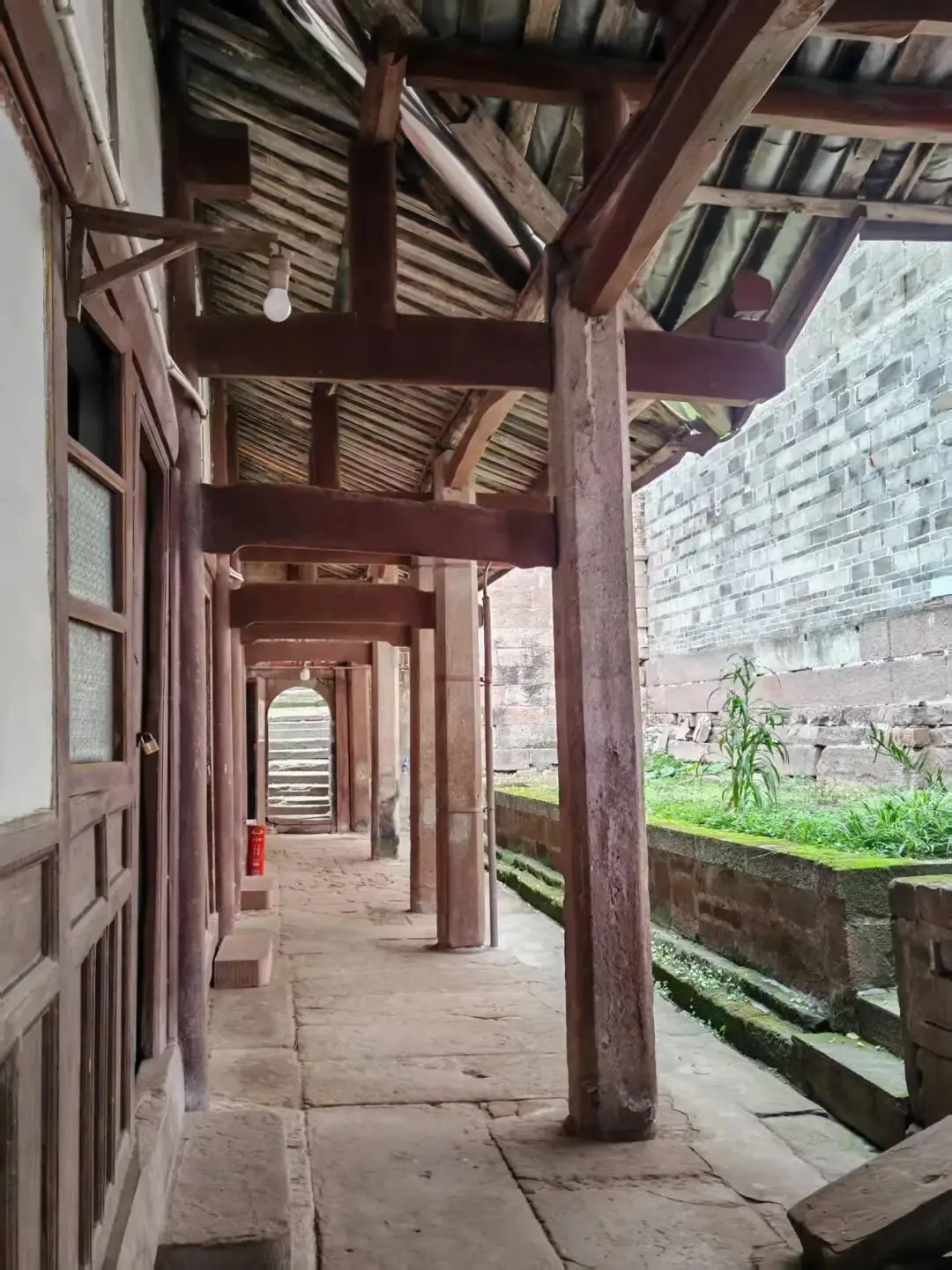
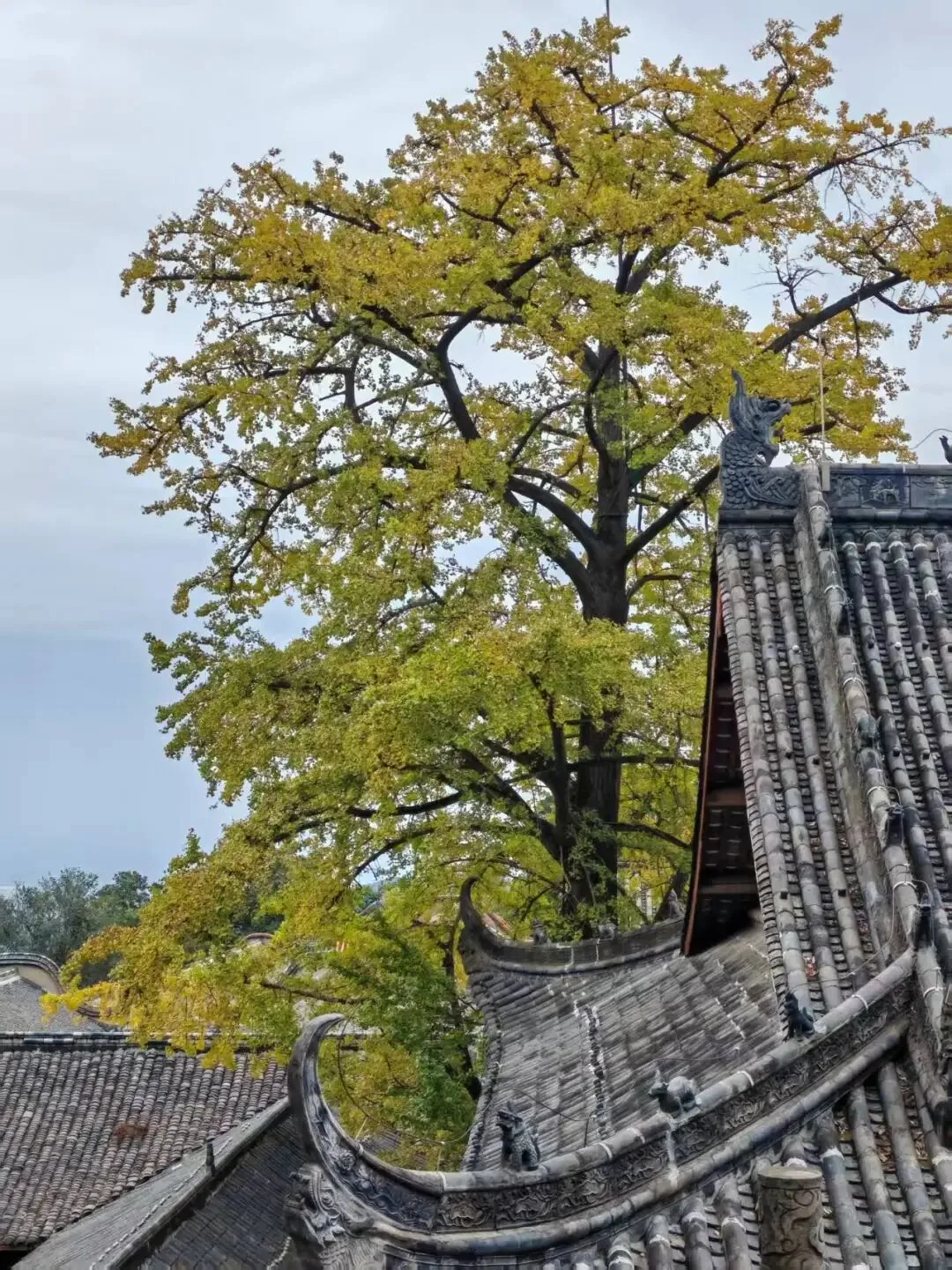
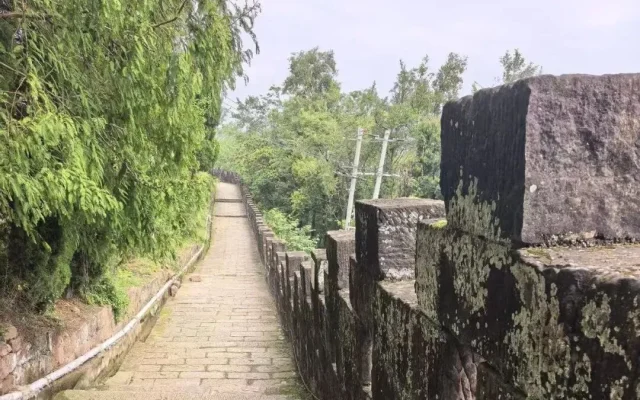
Inside the Yunding Stone City Scenic Area in Huaikou Subdistrict, two ancient “husband and wife” ginkgos stand in front of the Mahavira Hall. They’ve been rated among the “Ten Great Ancient Ginkgos of Tianfu.” Golden leaves carpet the temple steps. Pair them with the Southern Song-era Yunding Stone City, one of the “Eight Pillars of Shu.” It has 8 city gates plus a barbican, a straight wall, and cannon platforms. Seeing tree and fortress together carries more weight than photographing leaves alone.
Getting there: About 1 hour by car from Chengdu. Navigate to “Yunding Village Party Service Center” — the hiking trail entrance is right beside it. If you’d rather not climb, drive straight to Ciyun Temple’s summit parking lot. You can also take a train to Huaikou South Station (about 18 minutes), then a taxi (about 15 minutes).
Tickets: Free, no reservation needed. Parking 10 RMB per day. Ciyun Temple vegetarian meal starts at 11:30, 15 RMB per person.
Best time: Already about 80% yellow and in the viewing window. Expect a full canopy in a week. The golden period is short — just these two weekends. Small loop about 4 km, big loop 9–10 km (the big loop has many forks; download an offline map ahead). With kids, choose the small loop.
Nearby: Yunding Stone City, Wufengxi Ancient Town, Gongjia Mountain, Yuanjue Ancient Temple, Tuo River Small Three Gorges, Jintang mutton soup…
5. Dayi’s Baiyan Temple “Nine Sons” Ginkgo
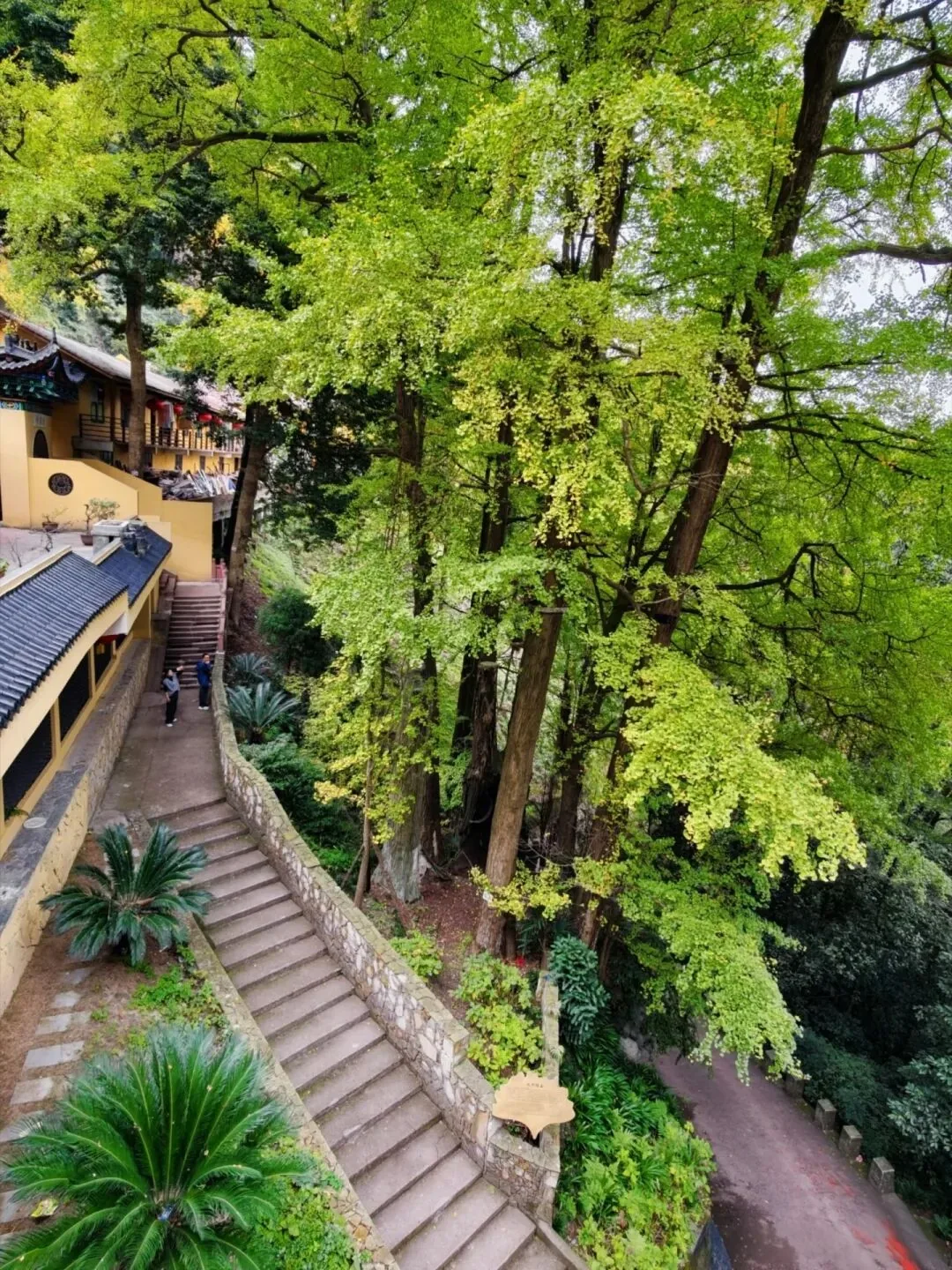
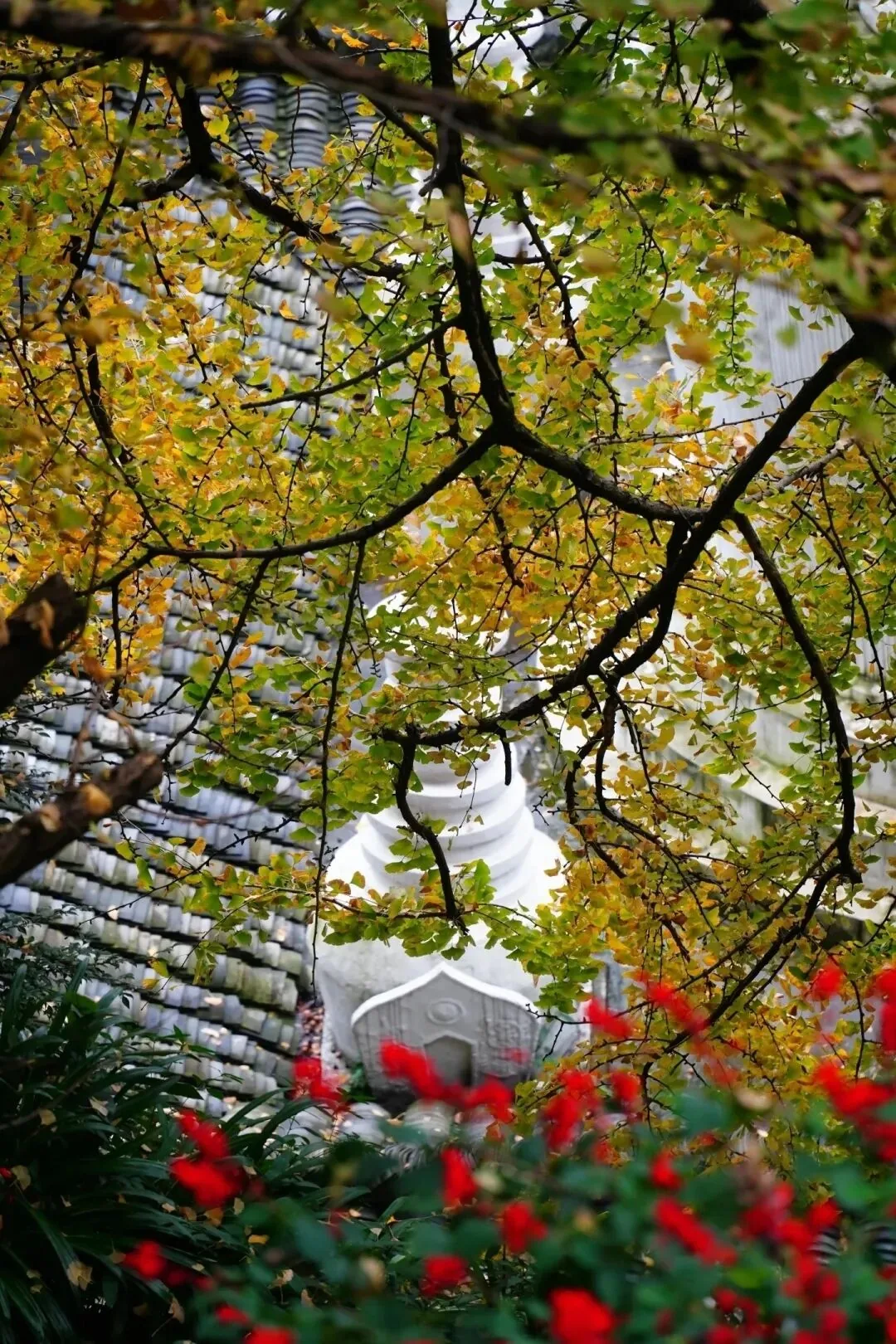
At the foot of Baiyan Mountain in Yuelai Town (formerly Jinxing Township). The temple was built in the Tang Dynasty and rebuilt during the Ming Wanli era, named for a giant jade-white rock face between two peaks. The temple’s treasure is the 1,200-year-old “Nine Sons Ginkgo” outside the mountain gate. After the mother tree was struck by lightning and died, nine shoots sprouted from the roots. They grew in a circle around the stump into towering trees. Around the temple are groves of ginkgo planted by Ming Dynasty monks. Stone steps flanked by canopies that meet overhead form a golden archway — the largest ginkgo forest around Chengdu.
Getting there: Navigate to “Baiyan Temple Parking Lot” (at the base), Tianbai Road, Yuelai Town, Dayi County. About 83 km from Chengdu, 1.5 hours, all asphalt and concrete road — sedans can make it. Parking 10 RMB per car; spaces are limited, so arrive before 9 AM on weekends.
Tickets: No ticket, no reservation. The temple serves vegetarian meals (about 11:30–13:00). At the base there are farmhouse restaurants and snack stalls; no shops on the mountain, so bring water.
Best time: Mid-to-late November to early December. Early November is still all green — don’t go too early. For a quiet visit, walk to the White Pagoda and Arhat Cave and turn back (about 1–2 hours). If you’re fit, continue on the roughly 8–9 km loop (about 4 hours); the later section is raw trail — avoid after rain.
Nearby: Jinyang Reservoir, Anren Ancient Town, Jianchuan Museum, Liu Family Manor, Xinchang Ancient Town, Xiling Snow Mountain, Huashuiwan…
6. Chongzhou’s Fengqi Mountain (Guangyan Zen Temple)
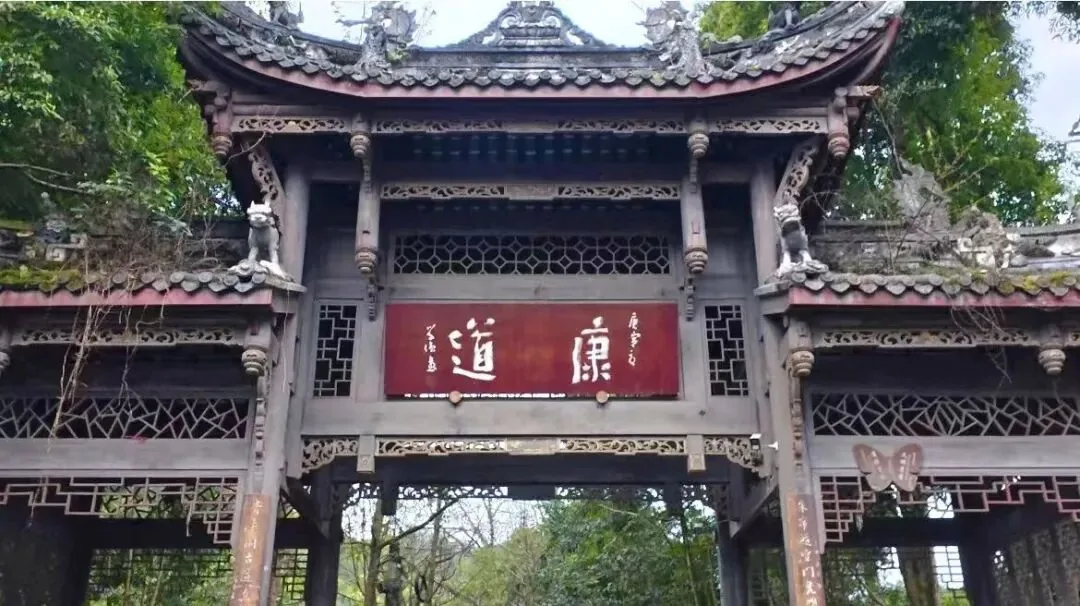
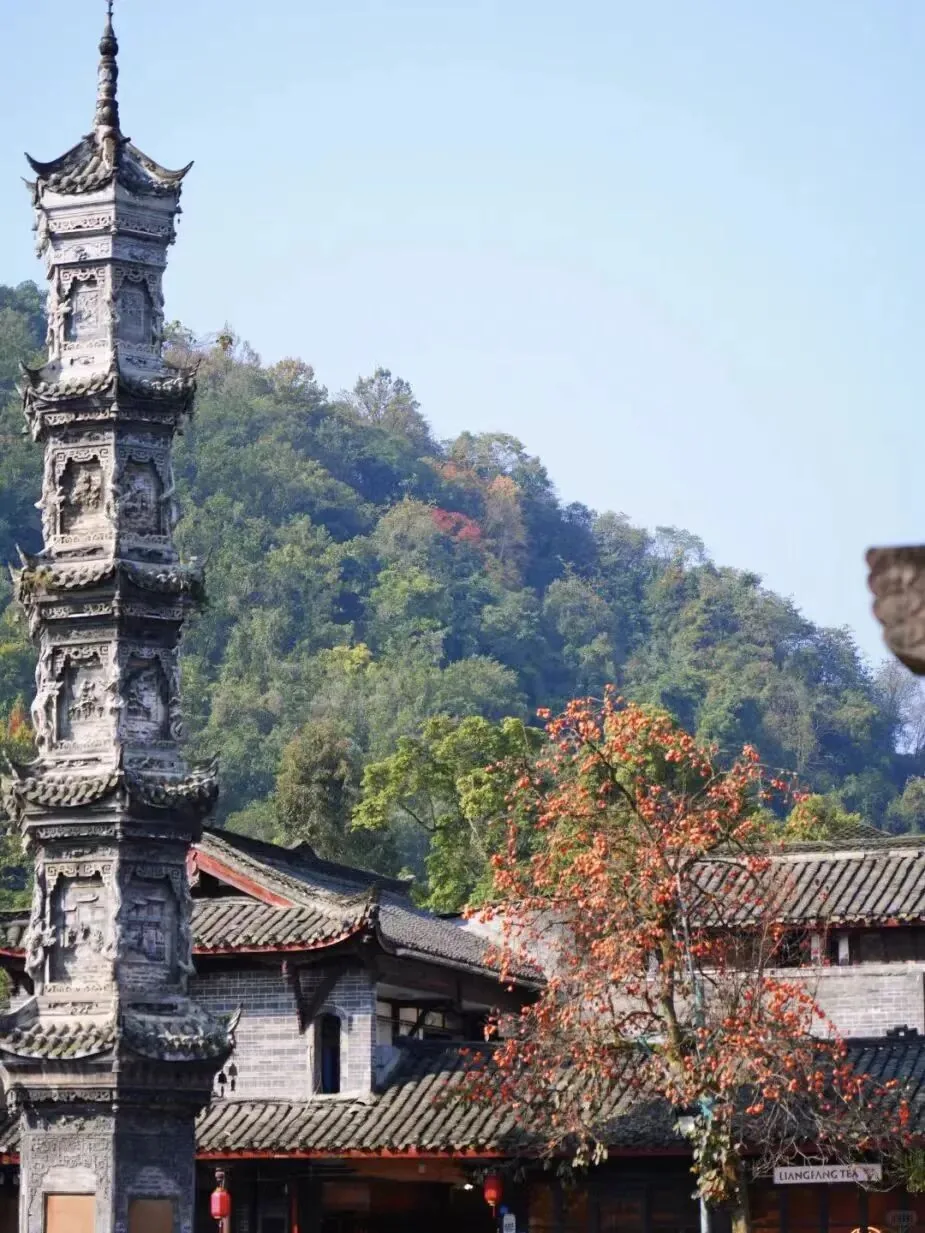
On Fengqi Mountain behind Jiezi Ancient Town, the Jin Dynasty Guangyan Zen Temple hides among nearly a thousand mu of ancient cypress, nanmu, fir, and ginkgo. The temple has upper and lower courtyards, two Mahavira Halls, a plaque in Emperor Kangxi’s handwriting, a Tang Dynasty stone sutra pillar, and a 1,700-year-old golden-thread nanmu tree. In autumn the old ginkgos turn yellow against gray temple tiles, with a bowl of vegetarian food — the most Zen of the six.
Getting there: Navigate to “Fengqi Mountain Kangdao” and hike up about 2–3 hours. About 1 hour by car from Chengdu. Or take the Xipu express train to Qingcheng Mountain Station (28–30 minutes, 10 RMB), then a taxi 15–20 minutes to Jiezi Ancient Town.
Tickets: Fengqi Mountain and Jiezi Ancient Town are free. Guangyan Zen Temple is open 8:00–17:30. Vegetarian meal starts at 11:30, 15 RMB per person; douhua (tofu pudding) 10 RMB per person; rice 2 RMB.
Best time: Late November to early December. For fewer crowds, go on a weekday — on the way down you can eat ye’er ba (leaf-wrapped rice cakes) and tangma bing (sesame cakes) in Jiezi.
Nearby: Jiezi Ancient Town, Weijiang River, Wulou Qiushan, Yuantong Ancient Town, Huaiyuan Ancient Town, Qingcheng Mountain, Dujiangyan…
6 City Spots — No Car Needed, Metro All the Way
City timing: All six are yellowest from late November to early December; most are still turning this year. All are metro-accessible, and you can string two or three together in half a day.
1. People’s Park
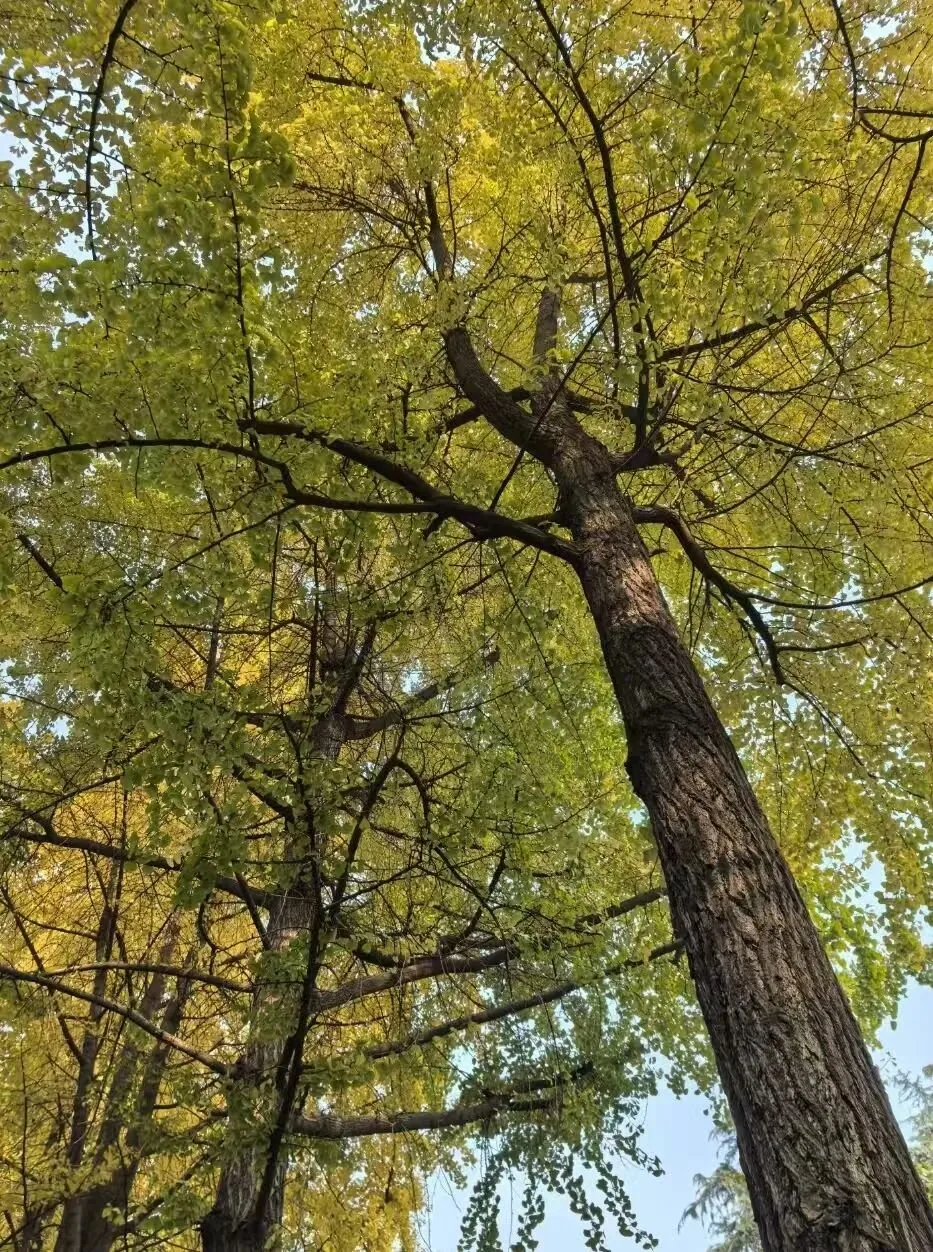
An old-school park on Cishi Street, with dozens of ginkgos lining a hundred-meter ginkgo path that ends at the Monument to the Martyrs of the 1911 Railway Protection Movement. After leaf-peeping, sit down at Heming Teahouse for a bowl of gaiwan tea — a dozen or so RMB buys you an afternoon. It’s the slowest way to see Chengdu’s ginkgo.
Getting there: 9 Cishi Street, Qingyang District. Metro Line 2 / Line 17, People’s Park Station.
Tickets: Free.
Nearby: Heming Teahouse, Kuanzhai Alley, Tianfu Square, Chengdu Museum, Qintai Road…
2. Wenshu Monastery
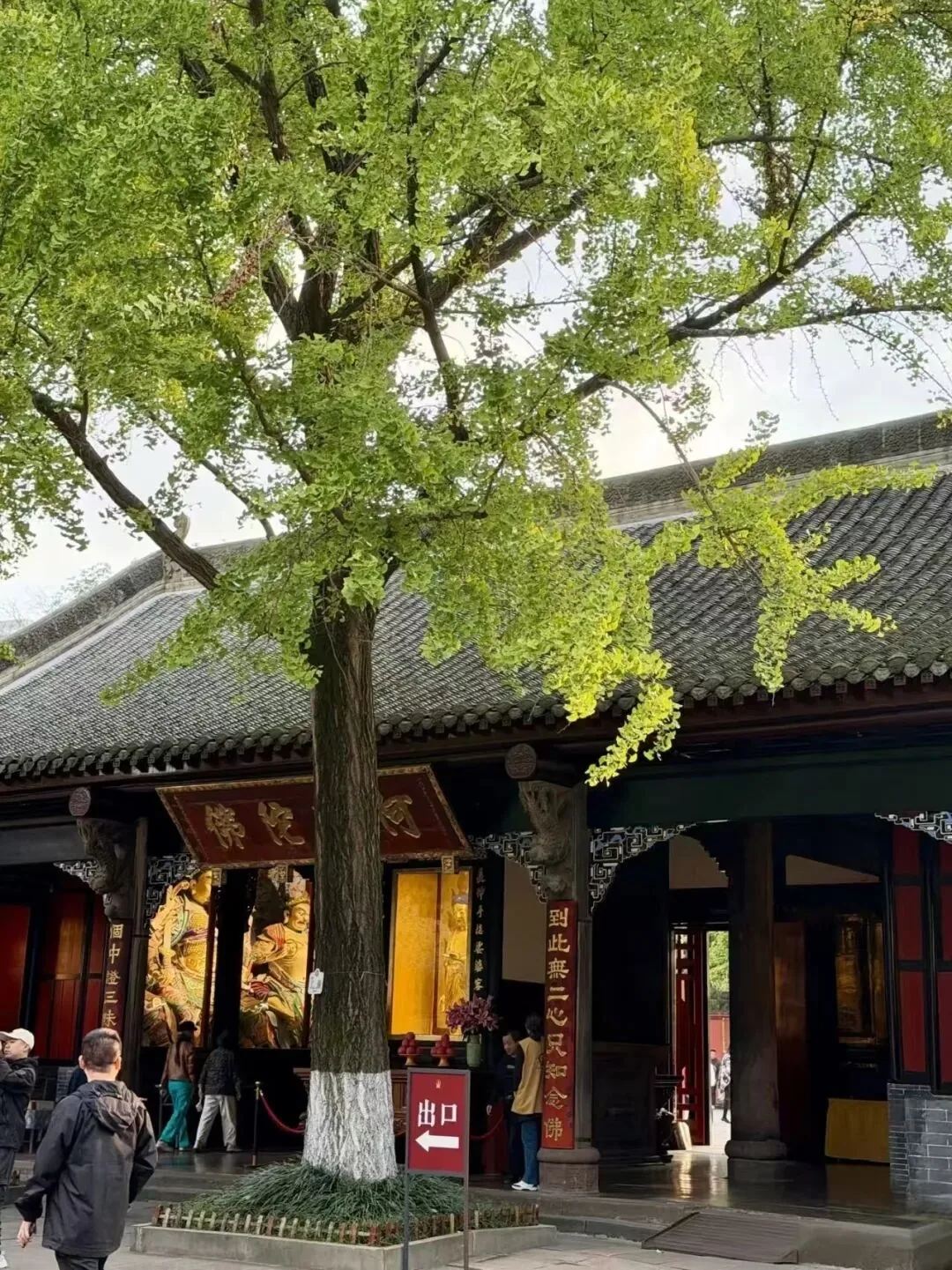
A famous ancient temple in western Sichuan. Two large old ginkgos at the entrance pair with red walls, the bell tower, and bluestone paving; golden leaves cover the ground — the top spot in the city for ancient-style photos. Walk further to the Konglin Buddhist Library area for another ginkgo grove where sunlight filters through the leaves.
Getting there: 66 Wenshu Monastery Street, Qingyang District. Metro Line 1, Wenshu Monastery Station. Open about 8:00–17:00; weekday early mornings are quietest.
Tickets: Free.
Nearby: Wenshufang, Xiangyuan vegetarian noodles, Dongzikou Zhang Lao’er liangfen (cold noodles), Daci Temple, Taikoo Li…
3. Baihuatan Park
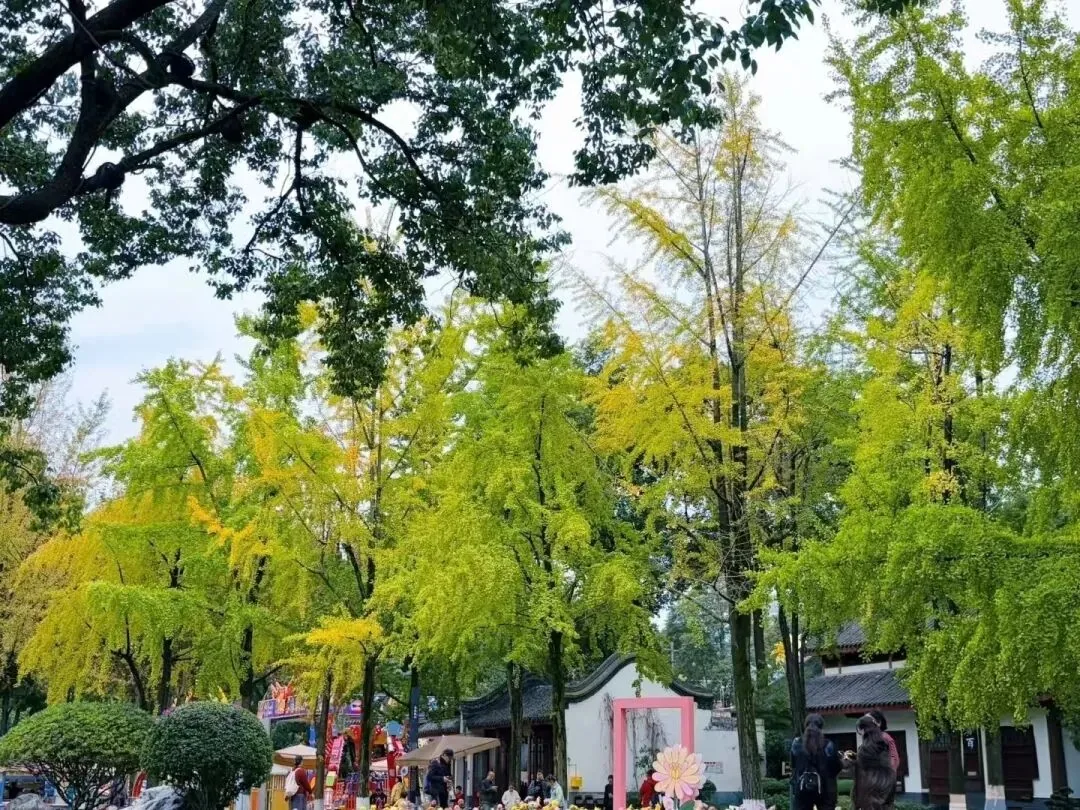
An old park on the south bank of Huanhua Creek. Inside is a thousand-year-old ginkgo (called “White Fruit Immortal”; age estimates range from 1,300 to 1,700 years), plus a Sichuan-style bonsai garden and Ginkgo Square. White walls, pond water, and yellow leaves in one frame — quiet, good for a slow stroll, no need to fight for a camera spot.
Getting there: 175 West Section 1, First Ring Road, Qingyang District (near Fanglin Road). Metro Line 5 / Line 13, Qingyang Palace Station.
Tickets: Free.
Nearby: Qingyang Palace, Culture Park, Qintai Road, Du Fu Thatched Cottage, Huanhuaxi Park, Sichuan Museum…
4. Qingyang Palace
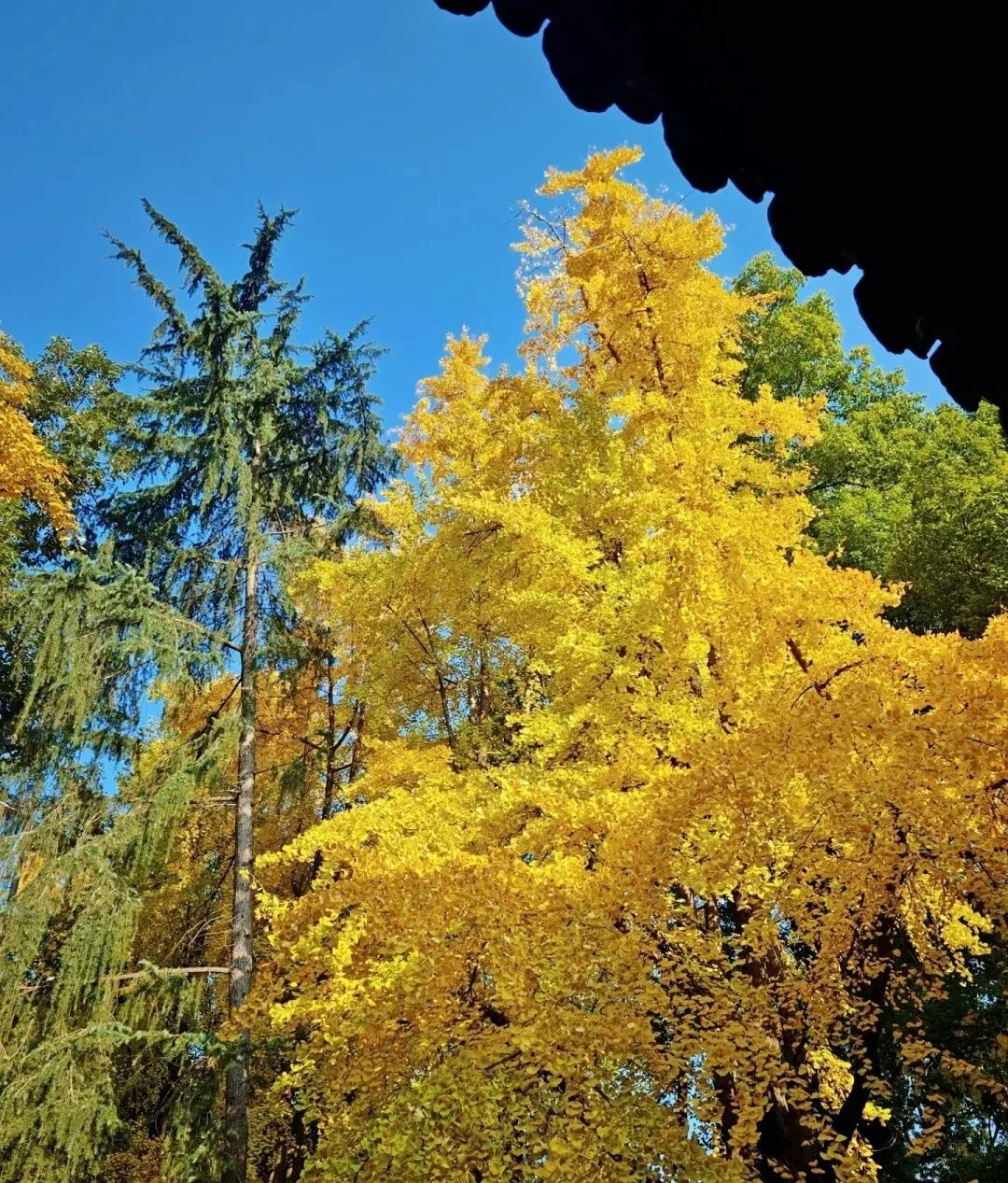
Western Sichuan’s foremost Taoist temple. Around the Bagua Pavilion and Sanqing Hall are century-old ginkgos; gray tiles and red walls with branches full of gold give it a more ethereal feel than the Buddhist temples. It’s small and relatively uncrowded — good for half an hour of quiet photography.
Getting there: 9 West Section 2, First Ring Road, Qingyang District. Metro Line 5 / Line 13, Qingyang Palace Station.
Tickets: 5 RMB.
Nearby: Baihuatan Park, Culture Park, Qintai Road, Du Fu Thatched Cottage, Huanhuaxi Park, Sanhua Tower…
5. Jinxiu Alley
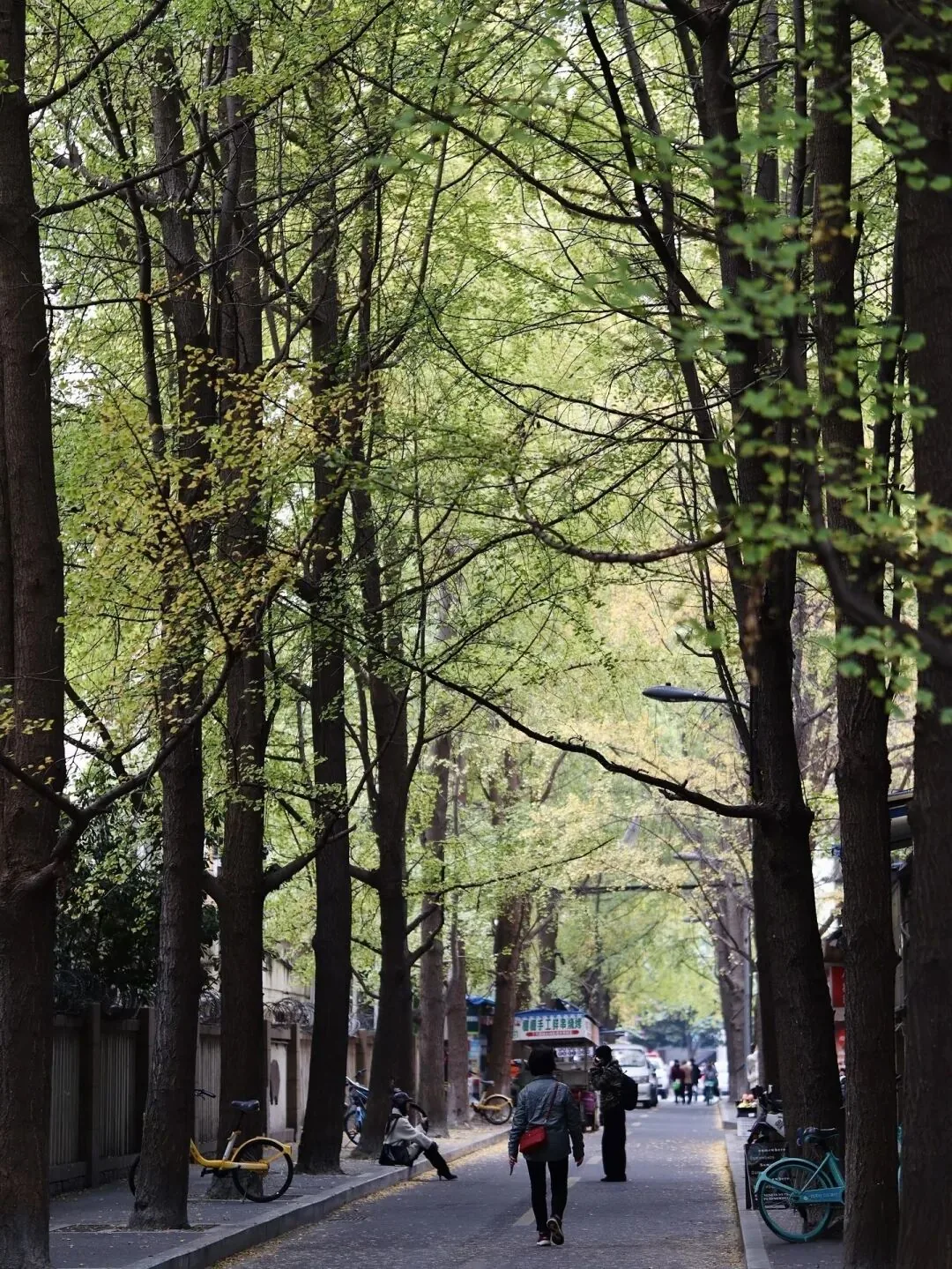
A small street next to Sichuan University’s Wangjiang campus, where ginkgo canopies meet overhead into a golden arch. During ginkgo season, cars are restricted and fallen leaves aren’t swept. Stand in the middle of the alley and look both ways — it’s the city’s most complete “golden tunnel.”
Getting there: Jinxiu Alley, Wuhou District. Metro Line 8, Sichuan University Wangjiang Campus Station Exit C, or Line 1, Nijiaqiao Station Exit D.
Tickets: Free; the street is open all day.
Nearby: Sichuan University Wangjiang Campus, Wangjianglou Park, Jiuyanqiao, Yulin Road, Nijiaqiao…
6. Jinniu Ginkgo Road
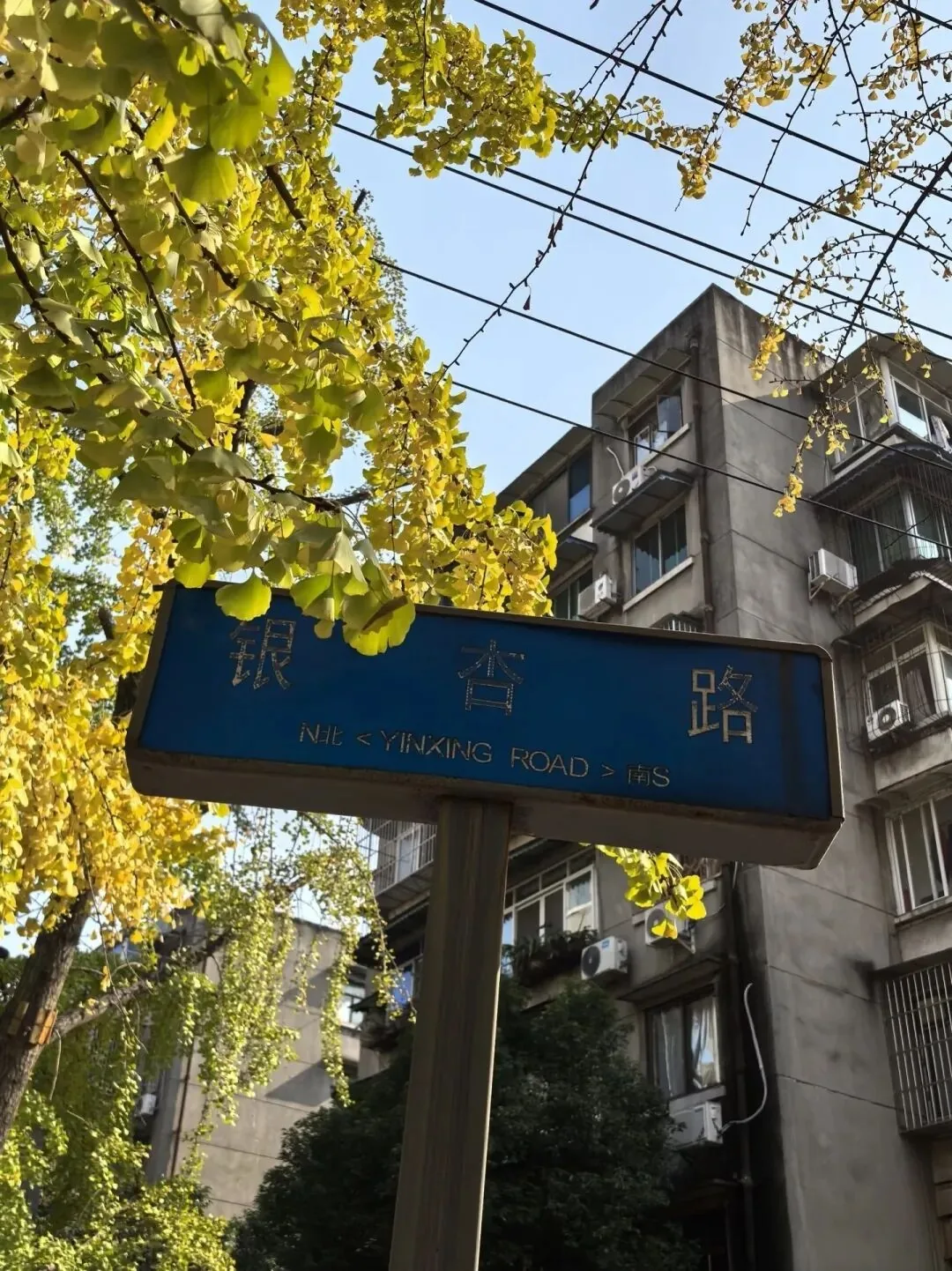
In the Baiguolin area of Jinniu District, this roughly 600-meter-old street has over a hundred ginkgos on both sides; in December it becomes a golden tunnel. Street vendors sell roasted sweet potatoes and sugar-roasted chestnuts. Leaves fall among old apartment buildings and balcony plants — the city’s most lived-in ginkgo scene.
Getting there: Baiguolin Ginkgo Road, Jinniu District. Metro Line 2, Baiguolin Station Exit C, a few minutes’ walk. Or locate “Ginkgo Road North Station” for buses.
Tickets: Free; the street is open all day. Cars and buses still pass through — watch traffic when taking photos.
Nearby: Baiguolin, Yongling Museum, Zaozixiang, Kuanzhai Alley, Xi’an South Road…
When to Go and How Not to Miss It
Timing: Mountain temples color up first in mid-November. Baiyan Temple, Yunding Mountain, and Qingcheng Mountain’s Tianshi Cave cluster from mid-to-late November to early December. City streets are mostly early December. The window is only two or three weeks — one cold rain and one windy night can drop half the leaves. Don’t plan for the latest possible date.
Getting to the outskirts: Driving is easiest — all six are within 1–1.5 hours. On weekends, arrive before 9 AM. None have direct metro. Public transport means “Xipu transfer to express train or bullet train, then taxi or rural bus.” Qingcheng Mountain, Dujiangyan, and Jiezi Ancient Town are the smoothest. Baiyan Temple, Yunding Mountain, and Gexian Mountain are best by car.
Getting around the city: All six are metro-accessible. – Wenshu Monastery: Line 1. – People’s Park and Baiguolin Ginkgo Road: Line 2. – Baihuatan and Qingyang Palace: Line 5 / Line 13, Qingyang Palace Station — they’re right next to each other. – Jinxiu Alley: Line 8, Sichuan University Wangjiang Campus Station. To link them into one route: Qingyang Palace → Baihuatan → Jinli West Road → People’s Park — ginkgo all the way.
Pro tip: The trees stay yellow for only two or three weeks. Pick a sunny day, see the old trees in the mountains first, then come back to the city for a bowl of tea.