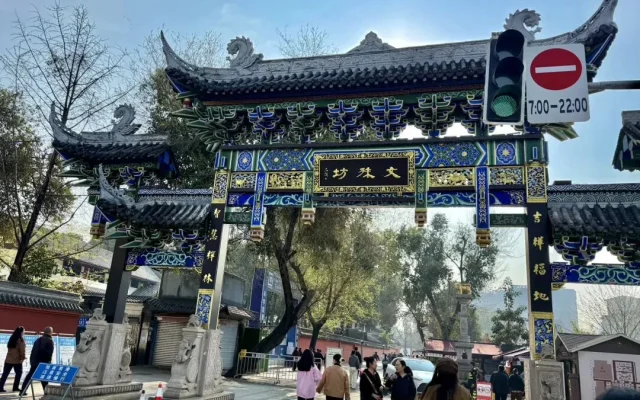
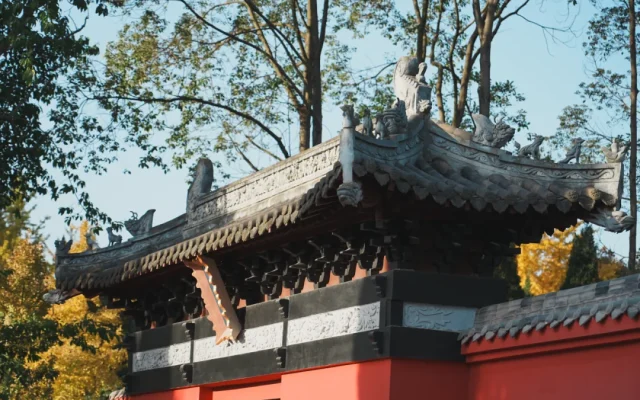
If you’re looking for a slice of old Chengdu that hasn’t been polished into a tourist trap, let me introduce you to Qingyang Gong (青羊宫, Green Ram Temple). Tucked right on the First Ring Road, just steps from the city’s non-stop traffic, this Taoist temple has been quietly doing its thing for over 2,600 years. It’s known as the ‘Number One Taoist Temple in Western Sichuan’ and the ‘First Taoist Forest of the Southwest’ — a majestic, red-walled sanctuary where ancient cypresses tower over golden-tiled roofs. For just 10 RMB, you can wander in, get a free bundle of incense, and experience a side of Chengdu that’s very different from the panda bases and hotpot joints.
Here’s the thing: unlike Qingcheng Mountain’s retreat deep in the hills, Qingyang Gong sits right in the urban hustle. It’s proof that Taoism here isn’t about escaping the world — it’s about finding calm right in the middle of it. You can snap photos at the famous Bagua Pavilion, rub the temple’s zodiac bronze goats for good luck, and then settle into a bamboo chair in the back courtyard with a bowl of gaiwan tea under century-old trees. It’s a perfect introduction to Sichuan Taoist culture and that quintessential old-Chengdu slow life.
Why This Temple Matters: A 2,600-Year-Old Story
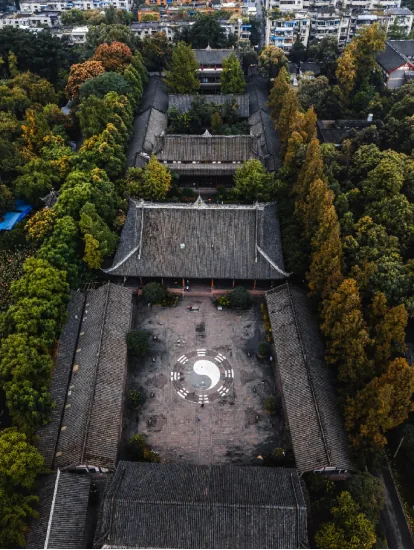
Qingyang Gong is located at 9 Yihuan Lu Xier Duan (一环路西二段9号) in Qingyang District, right by the bustling city center. It’s the only temple in Chengdu’s main city that blends both the Quanzhen and Zhengyi schools of Taoism, and it was built by imperial decree. The district itself is named after the temple — a sign of just how deep its roots go in this city’s cultural identity.
The Legend: Where Laozi Met Yin Xi
Originally, this spot was called ‘Qingyang Si’ (青羊肆), which literally means ‘Green Ram Market’ — a place where goats were traded on the city’s west side. According to Taoist texts, after Laozi wrote the Tao Te Ching at Hangu Pass, he told his disciple Yin Xi, ‘In a thousand days, come find me at the Green Ram Market in Chengdu.’ Years later, Yin Xi did exactly that, and there he met Taishang Laojun (the deified Laozi), who had transformed into a boy riding a green ram. This is how the temple got its name and became a sacred site of Taoist teaching.
From Market to Imperial Temple: Key Historical Moments
- Zhou Dynasty (origins): The site began as a simple market, but its connection to Laozi made it spiritually significant from the start.
- Three Kingdoms to Tang Dynasty (ascent): It was formally converted into a Taoist temple called ‘Qingyang Guan’ during the Three Kingdoms period. In the early Tang, it was renamed ‘Xuanzhong Guan’ and became the official Taoist center of Sichuan. Then came the big break: when Emperor Xizong of Tang fled to Sichuan during the Huang Chao Rebellion, he stayed at the temple and unearthed a brick inscribed with ‘Taishang Ping Zhonghe Zai.’ He took it as a divine omen, poured money into expanding the temple, and gave it the imperial name ‘Qingyang Gong’, elevating it from a local shrine to a royal temple with unmatched status in western Sichuan.
- Ming to Qing Dynasties (the current layout): War in the late Ming destroyed all the wooden halls from the Tang and Song. From 1667 to 1671 (the sixth to tenth years of the Kangxi Emperor’s reign), Quanzhen Taoist priests led a massive reconstruction, following strict Taoist rules of axial symmetry. This created the layout you see today: Shanmen (Mountain Gate), Lingzu Hall, Hunyuan Hall, Bagua Pavilion, Sanqing Hall, Doumu Hall, and Tangwang Hall. Later generations only did repairs — they never changed the overall structure.
- Modern era (a national treasure): In 1983, Qingyang Gong was listed as one of the first national key Taoist temples open to the public. It houses over 13,000 original pear-wood printing blocks for the Daozang Jiyao (道教辑要) from the Guangxu period of the Qing Dynasty — the only complete set of its kind in China and a world-class Taoist artifact. Today, it’s also the seat of the Sichuan Taoist Association.
A Living Cultural Landmark
Qingyang Gong isn’t just a temple; it’s a cornerstone of Chengdu’s identity. It’s the birthplace of Taoism in Sichuan, the only temple in China that connects the story of Laozi and Yin Xi with the ‘green ram’ legend, and home to:
- An architectural masterpiece: the Bagua Pavilion, a fully mortise-and-tenon structure with no nails, plus the only surviving Ming-dynasty wooden hall (Doumu Hall) and a Qing-dynasty official-style hall (Sanqing Hall).
- A global treasure: the complete set of Daozang Jiyao printing blocks, which draws scholars from around the world.
- A name that defined a district: Qingyang District is named after this temple, making it synonymous with a thousand years of Chengdu’s culture.
Walking the Central Axis: A Step-by-Step Tour of Qingyang Gong Temple
Qingyang Gong faces southwest, and the layout follows the Taoist principle of ‘low in the south, high in the north, rising tier by tier, with axial symmetry.’ The beauty of this is that you can walk the entire central axis without backtracking. Here’s the route:
Shanmen → Lingzu Hall → Hunyuan Hall → Bagua Pavilion → Sanqing Hall → Doumu Hall → Tangwang Hall → Erxian Nunnery + Taoist Culture Exhibition Hall + Ancient Tea Garden (back courtyard)
1. Shanmen (Mountain Gate) & the ‘Dao Fa Zi Ran’ Screen Wall
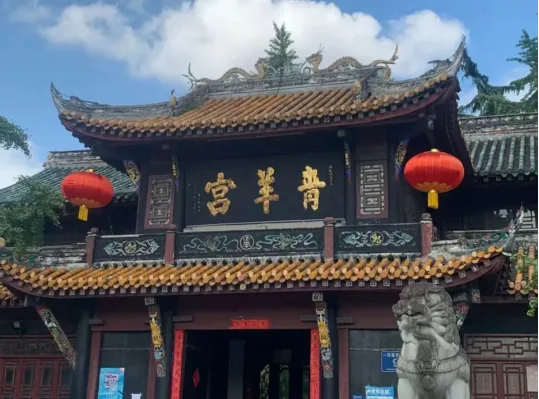
Your first stop is the Qing-dynasty Mountain Gate, a stunning example of double-eaved gable-roof architecture with yellow glazed tiles and deep red walls. The gold-lettered plaque reading ‘Qingyang Gong’ was written by An Hongde, a magistrate of Huayang County during the Qianlong reign — a first-class cultural relic in its own right.
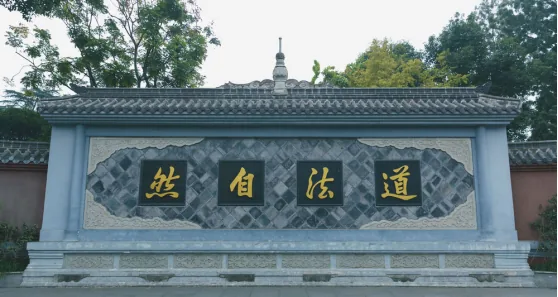
Right across from the gate is a massive bluestone screen wall carved with the four characters ‘道法自然’ (Dao Fa Zi Ran, ‘The Tao follows Nature’) — the spiritual core of Taoist philosophy. Keep an eye out for the pair of Ming-dynasty stone lions guarding the entrance; they’re a great spot for a period-style photo.
Local insight: That “道法自然” screen wall isn’t just decorative — it’s the philosophical key to understanding the entire temple. Snap a photo, but also take a second to read it.
2. Lingzu Hall: First Stop, Pay Your Respects
Pass through the Mountain Gate and you’ll hit Lingzu Hall, dedicated to Wang Lingguan, the protector deity of Taoism. It’s a tradition in Chinese Taoist temples to ‘pay respects to Lord Ling first’ before entering. The hall’s wooden carvings and bracket arches are prime examples of Qing-dynasty western Sichuan craftsmanship. The couplet on the pillars reads: ‘With three eyes, he sees all under heaven; with one whip, he startles the people of the world.’ It’s a reminder to leave your worldly distractions at the door.
3. Hunyuan Hall: Where It All Begins
The second major hall on the central axis, Hunyuan Hall is a Qing-dynasty wooden structure second only to Sanqing Hall in importance. It enshrines the statue of the Hunyuan Patriarch, Taishang Laojun (Laozi himself), holding a cosmic ring with a gentle, kind expression. The 28 stone pillars represent the 28 constellations, and the 8 wooden pillars stand for the 8 Dharma-protecting heavenly kings. Every beam and column is carved with intricate designs — phoenixes, auspicious beasts, and playful children — making this a masterpiece of Qing-dynasty Sichuan Taoist carving.
4. Bagua Pavilion: The Star of the Show
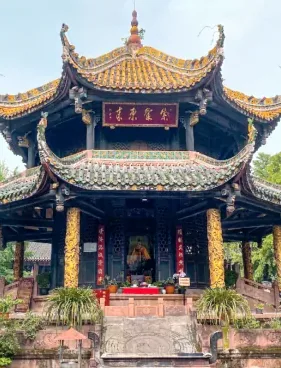
If you only see one thing at Qingyang Gong, make it the Bagua Pavilion (八卦亭). This is the temple’s most famous, most photographed, and most architecturally significant structure — so much so that it’s been called the ‘only surviving example of a Qing-dynasty southern Taoist octagonal pavilion.’
Here’s what makes it so special:
- Round sky, square earth: The pavilion sits on a three-tiered base — square at the bottom, octagonal in the middle, and round at the top — perfectly mirroring the Taoist cosmology of ’round heaven, square earth, eight trigrams, and the cycle of yin-yang.’
- No nails, no problem: The entire structure — columns, beams, eaves, and brackets — is held together by mortise-and-tenon joints. Not a single iron nail was used, and it’s survived over 300 years of earthquakes and weather.
- Dragons and divination: Eight pillars are carved with coiling dragons, and the ceiling is painted with the complete 64 hexagrams of the I Ching. In the center sits a stone sculpture of Laozi riding his green ox, capturing his legendary departure through Hangu Pass.
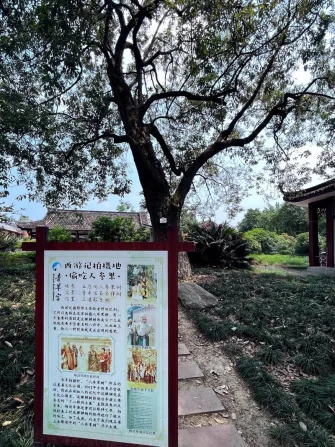
- A childhood memory: Remember the 1986 TV adaptation of Journey to the West? The scene where they steal the ginseng fruit was filmed right here. The Wuzhuang Guan exterior and the ginseng fruit tree were actually the ancient camphor tree behind the pavilion.
Pro tip: Walk around the pavilion slowly to appreciate the carvings on all eight sides. The dragon pillars are different on each column!
5. Sanqing Hall: Main Hall & the Zodiac Bronze Goats
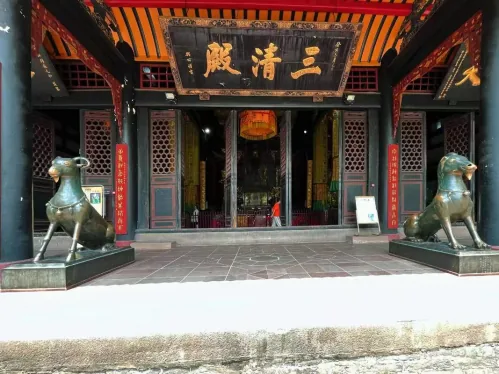
Climb the high platform behind the Bagua Pavilion and you’ll find Sanqing Hall, the main hall of the temple. First built in the Tang Dynasty and rebuilt in the eighth year of the Kangxi reign, this double-eaved, yellow-tiled hall is the largest Sanqing Hall in western Sichuan.
Inside, the ‘Three Pure Ones’ — Yuqing Yuanshi Tianzun, Shangqing Lingbao Tianzun, and Taiqing Daode Tianzun (Laozi) — sit in state at the center. Flanking them are the 12 Golden Immortals (including Guangchengzi, Chijingzi, Taiyi Zhenren, Manjushri, and Samantabhadra), the most complete set of clay sculptures of these figures in any southwestern Taoist temple. The hall also houses the ‘Mingzhong’ (Dark Bell), a Ming-dynasty bell weighing 3 tons that still rings on the first and fifteenth days of the lunar month, its sound echoing across the west side of the city.
The Zodiac Bronze Goats: Must-Touch Relics
On the terrace in front of Sanqing Hall, you’ll find the temple’s most beloved treasures: a pair of bronze rams. These aren’t just any statues — they’re the spiritual heart of Qingyang Gong.
- Left side: The single-horned goat (made in 1723, the first year of the Yongzheng reign). This one is the star. Donated by Grand Scholar Zhang Penghe, it was originally an artifact from the Red Plum Pavilion of Kaifeng in the Northern Song Dynasty. Here’s the wild part: this goat combines the features of all 12 zodiac animals. It has a rat’s ears, an ox’s body, a tiger’s paws, a rabbit’s back, a dragon’s horn, a snake’s tail, a horse’s mouth, a goat’s beard, a monkey’s head, a chicken’s eyes, a dog’s belly, and a pig’s rump. A poem is carved into its base. According to local custom, if you have an ailment, you gently rub the corresponding part of the goat’s body for good health and a smooth path in life. That’s why the statue is polished to a bright shine from all the affectionate touching.
- Right side: The two-horned goat (made in 1829, the ninth year of the Daoguang reign). Cast by a Yunnan artisan at the behest of a Chengdu believer named Zhang Kesi, this one serves as the companion goat. Its expression is gentler and its form more symmetrical.
Pro tip: Don’t be shy — give the single-horned goat a good rub. It’s what everyone else does, and tradition says it brings good luck.
6. Doumu Hall: Ming Dynasty Original & a Bibliographic Treasure
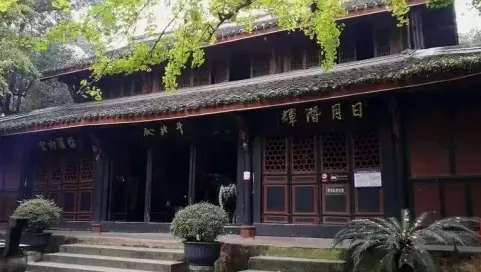
Behind Sanqing Hall sits Doumu Hall, the only hall in the temple to survive from the Ming Dynasty without a Qing-dynasty rebuild. This makes it exceptionally valuable for architectural historians. Inside, you’ll find Doumu Yuanjun, the Taoist goddess of the stars and mother of all stars, depicted with three eyes and four arms in a Ming-dynasty clay sculpture.
But the real treasure is in the scripture library next door. This is where Qingyang Gong houses its crown jewel: the complete set of 13,000-plus pear-wood printing blocks for the Daozang Jiyao, carved in the 32nd year of the Guangxu reign. These are double-sided, meticulously carved, and absolutely complete — the only full set of original Qing-dynasty Taoist canon printing blocks in existence. Scholars of Taoism and ancient texts from around the world make special trips just to study them.
7. Tangwang Hall: The Only Hall in China That Honors Emperors
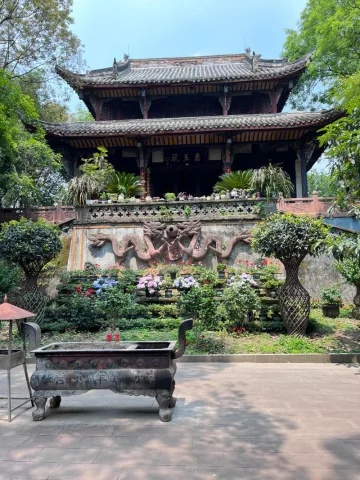
Here’s something you won’t see at other Taoist temples: Tangwang Hall, the final hall on the central axis, which enshrines statues of Tang Gaozu (Li Yuan), Tang Taizong (Li Shimin), and their consorts. Why? Because Qingyang Gong’s elevation to an imperial temple was thanks to Emperor Xizong of the Tang Dynasty, and later generations built this hall to honor the Li family’s support of Taoism. It’s a unique historical marker that sets this temple apart from every other Taoist site in China.
The two ancient ginkgo trees outside the hall are another highlight. Come in November, when their leaves turn a brilliant gold against the red walls — it’s one of the most beautiful autumn photo spots in Chengdu.
Also, in the side rooms of Tangwang Hall, you can draw a fortune stick (求签), get your fortune interpreted, or copy scriptures. All are official, free public services of the temple.
8. Erxian Nunnery & the Ancient Tea Garden: Taoist Slow Living
Head to the east side of the central axis and you’ll find Erxian Nunnery (二仙庵), which includes the Lüzu Hall (dedicated to Lü Dongbin), the Wenchang Hall (for academic success), the Yuanchen Hall (for the 60-year cycle of Tai Sui), and the Laozhuang Academy. This is where locals come to pray for good luck in exams or to make offerings to the Tai Sui star.
But the real hidden gem is the back courtyard’s Taoist tea house. Under the shade of hundred-year-old camphor and cypress trees, bamboo tables and chairs are set out, and for just 10-15 RMB you can get a bowl of gaiwan tea (choices include jasmine tea, bamboo-leaf green tea, and Bitan Piaoxue, a snowy-peak jasmine tea). One bowl, one afternoon — that’s the deal. Listen to the birds, watch the ancient trees, and let your mind drift. It’s the perfect embodiment of ‘tea as a path to Tao.’ And if you get hungry, the tea house serves simple Taoist vegetarian meals (15 RMB per serving) — a light, healthy option that locals swear by for a quiet, centered afternoon.
Hidden Gems for the Curious Visitor
Beyond the main axis, there are a few lesser-known spots that reward the patient explorer:
- Jiangsheng Tai & Shuofa Tai: Two rammed-earth platforms behind Tangwang Hall, said to be the original sites where Laozi was born and gave lectures to Yin Xi on the Tao Te Ching. These are the earliest surviving ground features of the temple.
- Lüzu Hall’s Eight Immortals Stone Carvings: A complete set of Qing-dynasty line carvings depicting the Eight Immortals crossing the sea and stories of Lü Dongbin’s enlightenment. The lines are flowing and delicate — a fine example of Sichuan stone carving.
- Qingyang Gong Kiln Site: On the north side of the temple lies the ruins of a Tang-dynasty kiln, an important archaeological site for studying Tang-era ceramics in western Sichuan. It’s listed as a provincial-level cultural relic.
- Laozhuang Academy & Taoist Culture Exhibition Hall: Open year-round and free to enter, this space displays Taoist ritual objects, scriptures, historical stone rubbings, and materials on the temple’s thousand-year history. A must-visit for anyone interested in the deeper story.
Visitor’s Guide: Everything You Need to Know
Tickets & Opening Hours
- Address: 9 Yihuan Lu Xier Duan, Qingyang District, Chengdu (成都市青羊区一环路西二段9号)
- Ticket price: 10 RMB for adults; 5 RMB for full-time students with a valid student ID; free for seniors 60+, children under 1.2 meters, active military personnel, and people with disabilities (with valid identification).
- Where to buy: Tickets are sold at the on-site window. No online reservation needed.
- Free incense: Each visitor receives 3 sticks of eco-friendly incense upon entry.
- Opening hours:
- Peak season (April 1 – October 31): 8:00 AM – 6:00 PM (last entry at 5:30 PM)
- Low season (November 1 – March 31): 8:00 AM – 5:30 PM (last entry at 5:00 PM)
- Suggested visit duration: About 1.5 hours if you’re just doing the highlights; allow 2.5-3 hours if you plan to have tea and really dig into the cultural relics.
Getting There
- Metro: Take Line 5 to Qingyang Gong Station (青羊宫站), exit from Gate B or C, and walk 100 meters to the front gate. Alternatively, take Line 2 to Tonghuimen Station (通惠门站) and walk about 10 minutes.
- Bus: Several lines stop at ‘Qingyang Gong Station’ (青羊宫站) — including 27, 34, 58, 82, and 170. The stop is right at the gate.
- Driving: Navigate to ‘Qingyang Gong’. There’s no dedicated parking lot, but you can park in the underground lot of the adjacent Wenhua Park (Culture Park) for 5 RMB per hour. Note that spots are limited on holidays.
A Final Thought
Qingcheng Mountain might be where Taoism goes to hide, but Qingyang Gong is where Taoism meets the daily grind — and that’s exactly its charm. It sits on Chengdu’s busiest ring road, with the roar of traffic on one side and the ancient peace of red walls, old cypresses, and morning bells on the other. As the old saying goes, “The small hermit hides in the mountains; the great hermit hides in the city.” That’s Qingyang Gong in a nutshell.
Laozi made his promise here 2,600 years ago. The Tang emperors elevated it to a royal temple. Qing-dynasty craftsmen built the nail-free Bagua Pavilion with nothing but skill and patience. Generations of Taoist masters have guarded the world’s only complete set of Daozang printing blocks. And today, Chengdu locals still happily spend 10 RMB to walk through the gate, give the bronze goats a rub, and sip gaiwan tea under the ancient trees — living out the principle of ‘Tao follows Nature’ in their everyday, ordinary, wonderful lives.